


Insulin Resistance: The Hidden Precursor to Cardiovascular Disease, Dementia, and Accelerated Aging

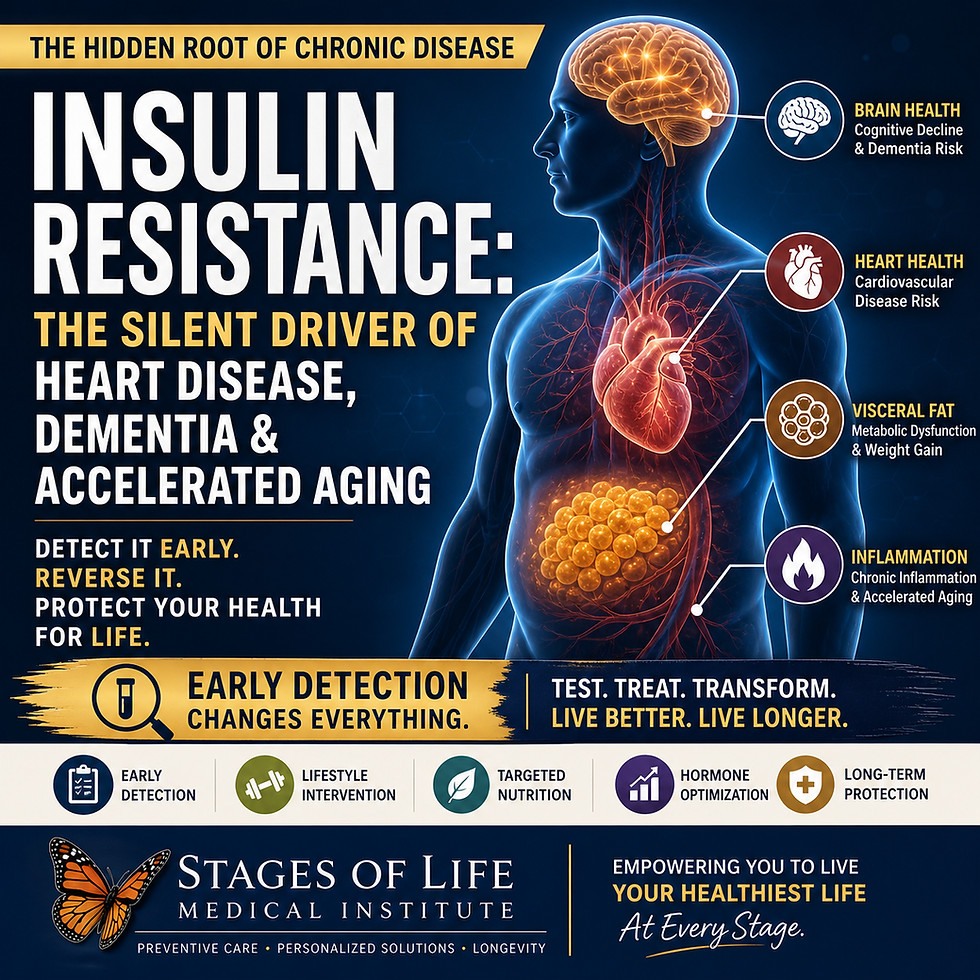
Insulin Resistance: Why It Matters More Than You Think
Most patients associate insulin resistance with diabetes. Clinically, that is far too late.
Insulin resistance is often present 10–20 years before diabetes develops¹, quietly driving:
Atherosclerosis
Hypertension
Chronic inflammation
Neurodegeneration
Visceral fat accumulation
By the time fasting glucose rises, significant metabolic injury has already occurred.
Insulin resistance occurs when cells no longer respond effectively to insulin, forcing the pancreas to produce increasing amounts to maintain normal glucose levels.
This results in:
Chronically elevated insulin (hyperinsulinemia)⁴
Impaired glucose uptake⁷
Increased fat storage⁵
Endothelial dysfunction¹
Over time, this creates a systemic metabolic imbalance affecting nearly every organ system.

1. Cardiovascular Disease
Insulin resistance contributes directly to:
Endothelial dysfunction¹
Increased triglycerides⁸
Reduced HDL⁸
Small dense LDL formation⁸
These changes accelerate plaque formation and vascular inflammation¹.
2. Dementia and Cognitive Decline
Insulin plays a critical role in brain signaling.
Insulin resistance in the brain is associated with:
Reduced neuronal glucose uptake²
Amyloid accumulation²
Tau phosphorylation²
This has led to the concept of Alzheimer’s disease as “Type 3 diabetes.”²
3. Accelerated Aging
Chronic hyperinsulinemia promotes:
Oxidative stress³
Mitochondrial dysfunction³
Chronic inflammation³
These processes accelerate biological aging³,¹⁰.

How Insulin Resistance Develops
The most common contributors include:
Excess refined carbohydrates and sugar⁵
Sedentary lifestyle⁷
Visceral adiposity⁵
Chronic stress (cortisol elevation)⁷
Poor sleep⁷
Importantly, insulin resistance can occur in normal-weight individuals⁹.
How to Detect Insulin Resistance Early
Standard glucose testing alone is insufficient.
More sensitive markers include:
Fasting insulin
HOMA-IR
Triglyceride/HDL ratio⁸
Hemoglobin A1c
HOMA-IR Calculation
HOMA-IR = Fasting Insulin × Fasting Glucose ÷ 405
Even modest elevations suggest early metabolic dysfunction⁶.

Clinical Approach to Reversal
1. Nutrition
Reduce refined carbohydrates and sugars⁵
Emphasize protein and healthy fats
Consider time-restricted eating
2. Exercise
Resistance training improves insulin sensitivity⁷
Aerobic exercise enhances glucose uptake⁷
3. Weight and Visceral Fat Reduction
Reducing abdominal fat is central to reversing insulin resistance⁵.
4. Targeted Supplementation
Evidence-supported options may include:
Berberine
Magnesium
Alpha-lipoic acid
Omega-3 fatty acids
These support insulin signaling and metabolic balance⁷.
5. Hormonal Optimization
Where appropriate:
Testosterone optimization
Thyroid balance
Cortisol regulation
These can significantly influence insulin sensitivity⁷.
Related Topics
Bottom Line
Insulin resistance is not simply a precursor to diabetes—it is a central driver of cardiovascular disease, dementia, and aging¹⁻³.
Early detection using appropriate laboratory markers allows for timely, effective intervention, often reversing the process before irreversible damage occurs⁶.
Call to Action
At Stages of Life Medical Institute, we focus on early detection and reversal of insulin resistance through comprehensive metabolic testing and personalized care.
👉 Become a Patient:https://stagesoflifemedicalinstitute.com
References
Reaven GM. Banting lecture 1988. Role of insulin resistance in human disease. Diabetes. 1988;37(12):1595–1607. https://pubmed.ncbi.nlm.nih.gov/3056758/
de la Monte SM. Insulin resistance and Alzheimer’s disease. BMB Rep. 2009;42(8):475–481. https://pubmed.ncbi.nlm.nih.gov/19754970/
Petersen MC, Shulman GI. Mechanisms of insulin action and insulin resistance. Physiol Rev. 2018;98(4):2133–2223. https://pubmed.ncbi.nlm.nih.gov/30067154/
Shanik MH, et al. Insulin resistance and hyperinsulinemia. Diabetes Care. 2008;31(Suppl 2):S262–S268. https://pubmed.ncbi.nlm.nih.gov/18227495/
Kahn SE, et al. Mechanisms linking obesity to insulin resistance. Nature. 2006;444(7121):840–846. https://pubmed.ncbi.nlm.nih.gov/17167471/
Craft S. Insulin resistance and cognitive decline. J Alzheimers Dis. 2005;7(1):53–62.
Samuel VT, Shulman GI. The pathogenesis of insulin resistance. Cell. 2012;148(5):852–871. https://pubmed.ncbi.nlm.nih.gov/22385956/
Grundy SM. Metabolic syndrome update. Circulation. 2008;117(25):e739–e743.
Lebovitz HE. Insulin resistance: definition and consequences. Exp Clin Endocrinol Diabetes. 2001;109(Suppl 2):S135–S148. https://pubmed.ncbi.nlm.nih.gov/11460565/
Ferrannini E, et al. Insulin resistance and aging. J Gerontol. 1993;48(Spec No):M43–M47.
The medical references cited in this article are provided for educational purposes only and are intended to support general scientific discussion. They are not a substitute for individualized medical advice, diagnosis, or treatment. Clinical decisions should always be made in consultation with a qualified healthcare professional who can account for a patient’s unique medical history, medications, and circumstances.


1917 Boothe Circle, Suite 171
Longwood, Florida 32750
Tel: 407-679-3337
Fax: 407-678-7246


.webp)