


Creatine: Is It Safe for Everyone? Hidden Kidney Risks and Safer Alternatives


Quick Look
Creatine is one of the most popular supplements for improving muscle mass and athletic performance, but it may not be appropriate for everyone. While generally considered safe in healthy individuals, concerns remain for patients with kidney disease, diabetes, hypertension, dehydration, or those taking medications that affect renal function. This article reviews potential risks, explains who should exercise caution, and discusses safer alternatives for preserving muscle mass and healthy aging.
Walk through any nutrition store, gym, or online supplement retailer and you will find creatine prominently displayed. Creatine has become one of the most popular supplements in the world, promoted for increasing muscle mass, improving athletic performance, and supporting healthy aging.
While many studies suggest creatine can be used safely by healthy individuals, there is an important question that is often overlooked:
Is creatine safe for everyone?
As physicians, we frequently encounter patients who begin supplements without considering underlying medical conditions, prescription medications, hydration status, or kidney function. In my own clinical practice, I have become increasingly concerned about patients presenting with declining renal function while taking creatine-containing products.
Although creatine may not be the sole cause of kidney injury in many cases, it may contribute to problems in susceptible individuals.
Understanding who may be at risk is essential.
What Is Creatine?
Creatine is a naturally occurring compound produced by the liver, kidneys, and pancreas.
It is also found in foods such as:
Beef
Fish
Pork
Poultry
The body uses creatine to regenerate adenosine triphosphate (ATP), the primary energy source used by muscles during short bursts of intense activity.
For this reason, creatine has become popular among:
Athletes
Bodybuilders
Fitness enthusiasts
Older adults attempting to maintain muscle mass

Why Creatine May Be More Complicated Than Advertised
Many consumers assume that because a supplement is sold over the counter, it must be safe.
Unfortunately, supplements do not undergo the same level of testing and regulatory oversight as prescription medications.
In addition, many users take:
Multiple supplements simultaneously
High-dose loading regimens
Protein powders
Energy drinks
Pre-workout formulations
This can make it difficult to determine which product is contributing to adverse effects.
Creatine Kidney Risk: It Raises Creatinine Levels
One of the most confusing aspects of creatine supplementation is that it often increases blood creatinine levels. Creatine is a serious kidney risk.
Creatinine is commonly used as a marker of kidney function.
When creatinine rises, physicians become concerned about possible kidney injury.
In some individuals, elevated creatinine simply reflects increased creatine metabolism rather than true kidney damage.¹
However, this creates a clinical dilemma:
Is the elevated creatinine harmless, or is it an early warning sign?
The answer is not always obvious.
Who Should Exercise Caution?
Most studies demonstrating safety were conducted in younger healthy adults.
Many patients seen in everyday medical practice are quite different.
Particular caution may be warranted in individuals with:
Chronic kidney disease
Diabetes
Hypertension
Congestive heart failure
History of kidney stones
Reduced hydration
Advanced age
High-protein diets
Concurrent use of NSAIDs
ACE inhibitors
ARBs
Diuretics
These patients may already have reduced renal reserve.
Adding additional metabolic stressors may increase risk.

Published Reports of Kidney Injury
Although uncommon, case reports have described:
Acute Interstitial Nephritis
An inflammatory condition affecting kidney tissue that can lead to sudden declines in kidney function.²
Acute Tubular Injury
Damage to the kidney's filtering structures has been reported in association with heavy supplementation and dehydration.³
Acute Kidney Injury
Several reports describe significant reductions in renal function occurring shortly after initiation of creatine-containing products.⁴
These reports do not prove causation in every case, but they do demonstrate that serious complications can occur under certain circumstances.
The Hidden Problem: Dehydration
One factor that receives surprisingly little attention is hydration.
Many creatine users:
Exercise intensely
Consume caffeine
Follow high-protein diets
Spend prolonged periods outdoors
All of these factors increase fluid requirements.
Older adults are particularly vulnerable because the sensation of thirst decreases with age.
The result can be a perfect storm:
Reduced hydration
Increased metabolic demand
Existing medical conditions
Supplement use
Together these may contribute to declining renal function.
Why Older Adults Need a Different Conversation
Much of the marketing surrounding creatine is aimed at preserving muscle mass during aging.
The goal is reasonable.
Loss of muscle mass (sarcopenia) is associated with:
Frailty
Falls
Fractures
Loss of independence
Increased mortality
However, many adults over age 60 also have:
Diabetes
Hypertension
Coronary artery disease
Early kidney disease
These patients are often very different from the young athletes studied in clinical trials.
As a result, supplementation decisions should be individualized rather than assumed to be universally safe.
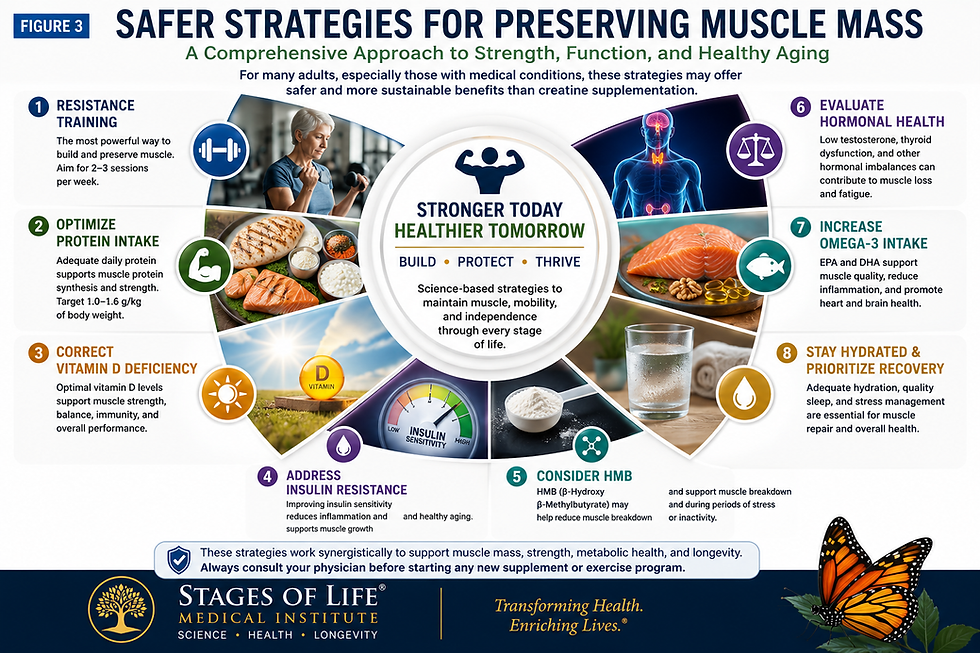
Safer Strategies for Preserving Muscle Mass
Resistance Training
Resistance exercise remains the most effective intervention for maintaining and building muscle.
Optimize Protein Intake
Many older adults consume insufficient protein.
A target intake of approximately 1.0–1.6 grams per kilogram of body weight daily may help support muscle maintenance.
Correct Vitamin D Deficiency
Vitamin D plays an important role in muscle strength, balance, and physical performance.
Address Insulin Resistance
One of the most overlooked causes of muscle loss is insulin resistance.
Consider HMB
β-Hydroxy β-Methylbutyrate (HMB) may help reduce muscle breakdown and support healthy aging.
Evaluate Hormonal Health
Low testosterone, thyroid dysfunction, and other hormonal abnormalities can contribute to loss of muscle mass and physical performance.
Increase Omega-3 Intake
DHA and EPA have been associated with improvements in muscle quality, inflammation control, and healthy aging.
Bottom Line
Creatine is one of the most widely used supplements in the world and appears to be safe for many healthy individuals when used appropriately. However, it is not necessarily appropriate for everyone.
Individuals with diabetes, hypertension, kidney disease, dehydration, or those taking medications that affect kidney function should discuss supplementation with their physician before use.
Maintaining muscle mass is important for healthy aging, but resistance training, proper nutrition, vitamin D optimization, correction of insulin resistance, and management of hormonal deficiencies may offer safer and more sustainable long-term solutions for many adults.
Related Topics
Become a Patient
At Stages of Life Medical Institute, we take a comprehensive approach to healthy aging, muscle preservation, metabolic health, and kidney function.
Our evaluations may include:
Advanced laboratory testing
Kidney function assessment
Hormonal evaluation
Insulin resistance screening
Nutritional analysis
Personalized wellness planning
Whether your goal is maintaining strength, improving energy, protecting kidney health, or optimizing longevity, our team can help develop a personalized strategy based on your unique medical profile.
References
Kreider RB, Kalman DS, Antonio J, et al. International Society of Sports Nutrition Position Stand: Safety and efficacy of creatine supplementation in exercise, sport, and medicine. J Int Soc Sports Nutr. 2017;14:18.
Koshy KM, Griswold E, Schneeberger EE. Interstitial nephritis in a patient taking creatine. N Engl J Med. 1999;340(10):814-815.
Pritchard NR, Kalra PA. Renal dysfunction accompanying oral creatine supplements. Lancet. 1998;351(9111):1252-1253.
Thorsteinsdottir B, Grande JP, Garovic VD. Acute renal failure in a young weight lifter taking multiple food supplements, including creatine monohydrate. J Ren Nutr. 2006;16(4):341-345.
Candow DG, Forbes SC, Chilibeck PD, et al. Variables influencing the effectiveness of creatine supplementation as a therapeutic intervention for sarcopenia. Front Nutr. 2019;6:124.
Devries MC, Phillips SM. Supplemental protein in support of muscle mass and health. Curr Opin Clin Nutr Metab Care. 2015;18(3):248-253.
Rondanelli M, Klersy C, Terracol G, et al. Whey protein, amino acids, and vitamin D supplementation in sarcopenia. Aging Clin Exp Res. 2016;28(5):793-805.
Liao CD, Tsauo JY, Wu YT, et al. Effects of protein supplementation combined with resistance exercise in older adults. Am J Clin Nutr. 2017;106(4):1078-1091.
Ceglia L. Vitamin D and skeletal muscle tissue. Curr Opin Clin Nutr Metab Care. 2009;12(6):628-633.
Smith GI, Julliand S, Reeds DN, et al. Fish oil-derived omega-3 fatty acids increase muscle protein synthesis. Clin Sci (Lond). 2015;129(6):467-479.
The medical references cited in this article are provided for educational purposes only and are intended to support general scientific discussion. They are not a substitute for individualized medical advice, diagnosis, or treatment. Clinical decisions should always be made in consultation with a qualified healthcare professional who can account for a patient’s unique medical history, medications, and circumstances.


1917 Boothe Circle, Suite 171
Longwood, Florida 32750
Tel: 407-679-3337
Fax: 407-678-7246


.webp)