


Low-Grade Fever: When a Slight Temperature Elevation May Mean More Than You Think

Quick Look
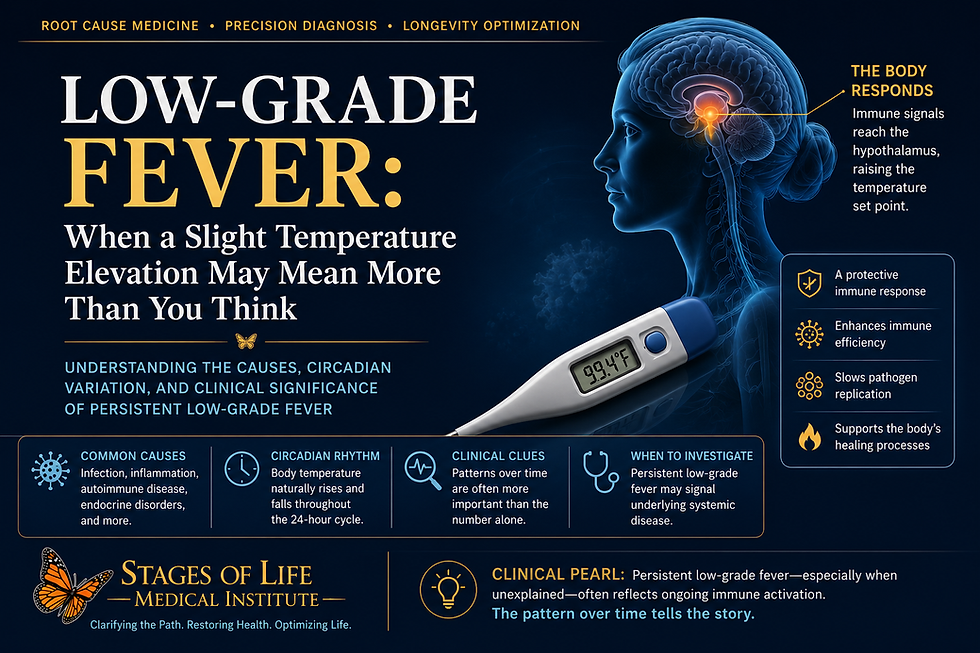
A body temperature that is only slightly elevated is often dismissed as unimportant. In reality, persistent low-grade fever may reflect infection, inflammation, endocrine dysfunction, immune activation, or even early systemic disease. Understanding when temperature is measured—and how the body naturally regulates temperature over a 24-hour circadian cycle—is critical for accurate interpretation.
Introduction
Most people associate fever with temperatures above 101°F, chills, and obvious illness. But medicine often teaches a different lesson: subtle physiologic abnormalities frequently provide more diagnostic information than dramatic ones.
A low-grade fever, generally defined as a temperature between 99.0°F and 100.3°F, often represents the body’s response to immune activation, inflammation, infection, or metabolic stress. In some situations, persistent low-grade fever may be far more clinically meaningful than a brief spike in temperature during a common viral illness.
Understanding why temperature rises requires understanding how the body regulates heat.
What Is Considered a Low-Grade Fever?
Normal human body temperature is often cited as 98.6°F (37°C), although modern studies suggest that healthy adults frequently run somewhat lower.
Typical temperature ranges include:
97.0–98.6°F → normal physiologic range
99.0–100.3°F → low-grade fever
100.4°F and above → clinically significant fever
Temperature alone, however, rarely tells the entire story.
The Immune System Often Creates Fever Intentionally
Fever is not simply an abnormality.
It is a highly regulated physiologic response orchestrated by the hypothalamus. When the immune system detects infection or inflammation, inflammatory signaling molecules including Interleukin-1, Tumor Necrosis Factor-alpha, and Prostaglandin E2 alter the hypothalamic temperature set point, deliberately increasing body temperature.¹
This mild increase in temperature helps:
Slow bacterial replication
Improve immune cell efficiency
Enhance leukocyte mobility
Increase production of protective proteins involved in immune defense

Common Causes of Low-Grade Fever
Several conditions may cause mild but persistent temperature elevation.
Infectious Causes
Viral infections
Urinary tract infections
Chronic sinus infections
Dental infections
Tick-borne illness
Chronic prostatitis
Inflammatory Causes
Persistent immune activation may produce prolonged mild fever in conditions such as:
Autoimmune disease
Rheumatoid arthritis²
Lupus³
Inflammatory bowel disease
Endocrine and Metabolic Causes
Certain metabolic conditions increase heat production.
Examples include:
Hyperthyroidism⁴
Excess catecholamine release
Medication reactions
Sympathetic nervous system overactivation
Circadian Variation in Body Temperature: Why Timing Matters
One often overlooked factor in interpreting a “low fever” is the body’s normal circadian rhythm of temperature regulation.
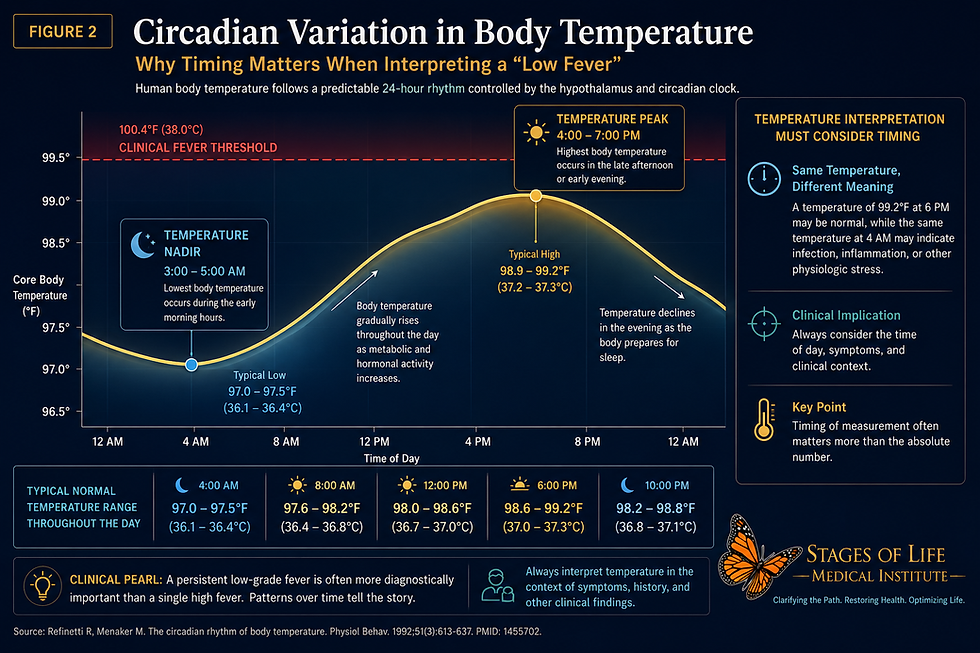
Human body temperature follows a predictable 24-hour biologic cycle controlled through the hypothalamus and coordinated by the body’s internal clock, known as the circadian rhythm.⁵
In most healthy adults:
Lowest temperature occurs between 3 AM and 5 AM
Typical early morning temperatures may fall to 97.0–97.5°F
Temperature gradually rises throughout the day
Peak temperatures occur between 4 PM and 7 PM
Evening temperatures of 98.9–99.2°F may be completely normal physiology
This means a temperature of 99.2°F at 6 PM may be entirely normal, while the same temperature measured at 4 AM may strongly suggest infection, inflammation, or abnormal physiologic stress.
The timing of temperature measurement often matters more than the absolute number.
Clinical Pearl
A physician should be more concerned about 99.5°F every evening for three weeks than 102°F for one day during an obvious viral illness.
Persistent low-grade fever often suggests ongoing immune activation, and the pattern over time frequently provides more diagnostic information than the peak temperature itself. In medicine, subtle abnormalities often reveal the earliest signs of disease.
Sometimes It Means Almost Nothing
Transient mild temperature elevation may simply reflect normal physiology.
Examples include:
Recent exercise
Heat exposure
Dehydration
Ovulation
Emotional stress
Recovery after poor sleep
Normal circadian temperature fluctuation
Not every elevated temperature indicates illness.
More Concerning Situations
Persistent low-grade fever deserves attention when accompanied by:
Night sweats
Unexplained fatigue
Enlarged lymph nodes
Persistent cough
Weight loss
Chronic joint pain
Recurrent urinary symptoms
Gastrointestinal symptoms
Possible underlying causes may include:
Hidden abscess formation
Chronic infection
Autoimmune disease
Endocarditis⁶
Hematologic malignancy such as lymphoma⁷

Bottom Line
Low-grade fever should never be interpreted in isolation. The body intentionally raises temperature when the immune system detects physiologic stress, inflammation, infection, or metabolic disturbance. Just as important, body temperature naturally fluctuates throughout the day according to circadian rhythm.
A temperature that appears mildly abnormal at one time of day may be completely normal at another. Persistent low-grade fever—especially when unexplained—often warrants thoughtful investigation.
Sometimes, the body whispers long before it begins to scream.
Related Topics
Become a Patient
At Stages of Life Medical Institute, we focus on identifying the root causes of chronic inflammation, persistent immune activation, metabolic dysfunction, hormonal imbalance, and early disease processes before they become major health problems.
If unexplained symptoms persist, earlier evaluation often leads to better outcomes.
References
1. Dinarello CA. Infection, fever, and exogenous and endogenous pyrogens. Journal of Endotoxin Research. 2001. PMID: 11521070.PubMed: View PubMed Reference
2. McInnes IB, Schett G. The pathogenesis of rheumatoid arthritis. New England Journal of Medicine. 2011. PMID: 22913681.PubMed: View PubMed Reference
3. Tsokos GC. Systemic lupus erythematosus. New England Journal of Medicine. 2011. PMID: 31633807.PubMed: View PubMed Reference
4. De Leo S, Lee SY, Braverman LE. Hyperthyroidism. The Lancet. 2016. PMID: 28781058.PubMed: View PubMed Reference
5. Refinetti R, Menaker M. The circadian rhythm of body temperature. Physiology & Behavior. 1992. PMID: 1455702.PubMed: View PubMed Reference
6. Cahill TJ, Prendergast BD. Infective endocarditis. The Lancet. 2016. PMID: 28231908.PubMed: View PubMed Reference
7. Armitage JO. Early-stage Hodgkin lymphoma. New England Journal of Medicine. 2010. PMID: 30786186.PubMed: View PubMed Reference
8. Mackowiak PA. Concepts of fever. Archives of Internal Medicine. 1990. PMID: 2193134.PubMed: View PubMed Reference
9. Evans SS et al. Fever and the thermal regulation of immunity. Nature Reviews Immunology. 2015. PMID: 19104476.PubMed: View PubMed Reference
10. Kluger MJ. Fever physiology and immunology. Reviews of Infectious Diseases. 1985. PMID: 3906580.PubMed: View PubMed Reference
The medical references cited in this article are provided for educational purposes only and are intended to support general scientific discussion. They are not a substitute for individualized medical advice, diagnosis, or treatment. Clinical decisions should always be made in consultation with a qualified healthcare professional who can account for a patient’s unique medical history, medications, and circumstances.


1917 Boothe Circle, Suite 171
Longwood, Florida 32750
Tel: 407-679-3337
Fax: 407-678-7246


.webp)