


Hashimoto’s Thyroiditis: Diagnosis, Root Causes, and Modern Treatment Strategies


Quick Look
Hashimoto’s thyroiditis is the leading cause of hypothyroidism in developed nations and affects millions of people, particularly women. Yet many patients are told their thyroid function is “normal” despite symptoms such as fatigue, hair loss, weight gain, depression, and cognitive decline. Proper diagnosis requires more than a basic TSH test. Understanding autoimmune triggers, nutritional deficiencies, inflammation, gut health, and treatment options may significantly improve outcomes before permanent thyroid destruction occurs.
Hashimoto’s Thyroiditis: More Than Low Thyroid Function
Hashimoto's thyroiditis is the most common autoimmune endocrine disorder worldwide. It occurs when the immune system gradually attacks thyroid tissue, leading to progressive destruction of the gland and declining hormone production.
Unlike simple hypothyroidism, Hashimoto’s is fundamentally an immune dysregulation disorder first and a hormone deficiency second.
Patients are often treated only after significant glandular destruction has already occurred.
The challenge is that early disease frequently presents long before conventional laboratory abnormalities become obvious.
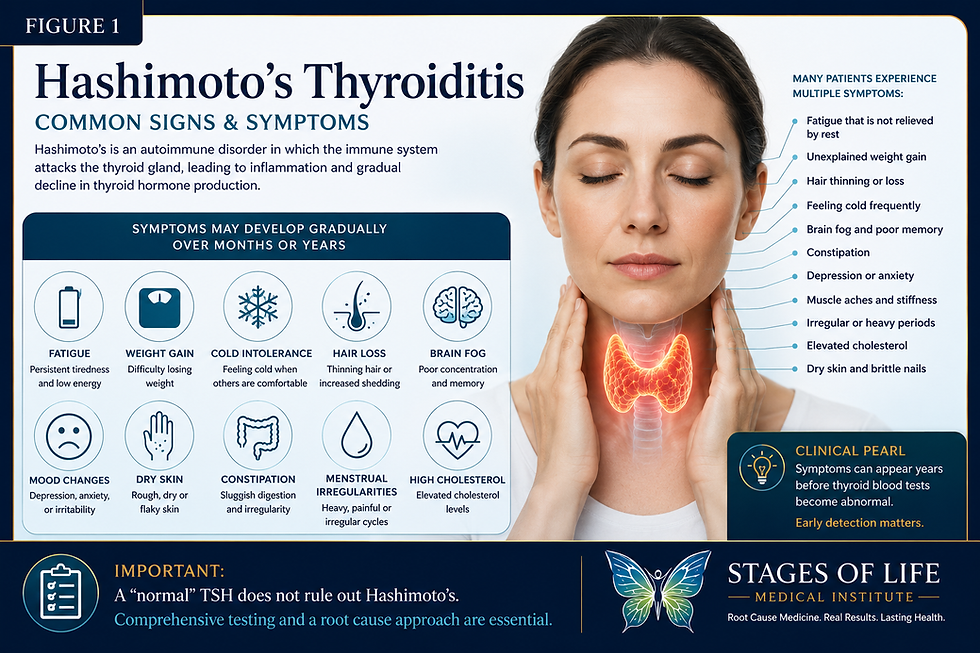
Common symptoms include:
Persistent fatigue
Weight gain despite unchanged diet
Cold intolerance
Hair thinning or hair loss
Depression or anxiety
Dry skin
Brain fog
Constipation
Elevated cholesterol
Menstrual irregularities
Reduced exercise tolerance
The Immune System Attacks the Thyroid
In Hashimoto’s disease, immune cells begin producing antibodies directed against thyroid proteins, particularly:
Thyroid Peroxidase Antibodies (TPO-Ab)
Thyroglobulin Antibodies (Tg-Ab)
These antibodies recruit inflammatory immune cells that progressively damage thyroid tissue over years or decades. This inflammatory process often precedes clinical hypothyroidism by many years.
Over time:
Normal thyroid → Autoimmune inflammation → Progressive gland destruction → Reduced hormone production → Clinical hypothyroidism

The Problem with Standard Diagnosis
Many physicians rely exclusively on TSH (Thyroid Stimulating Hormone) testing.
Thyroid-stimulating hormone is useful, but often insufficient. A patient may have active autoimmune thyroid destruction for years while TSH remains within “normal” laboratory reference ranges.
A more complete thyroid evaluation often includes:
Basic Testing
TSH
Free T4
Free T3
TSH
Autoimmune Testing
TPO Antibodies
Thyroglobulin Antibodies
Functional Evaluation
Reverse T3
Free T3
Free T4
Thyroid ultrasound when indicated
Basal body temperature tracking
At Stages of Life Medical Institute, we frequently evaluate patients who have symptoms consistent with thyroid dysfunction despite prior “normal” testing.
What Causes Hashimoto’s Disease?
The exact cause remains multifactorial. Several triggers are commonly associated with autoimmune thyroid activation.
1. Genetic Predisposition
Family history strongly influences susceptibility. Genes involving immune regulation increase vulnerability.
2. Excessive Chronic Stress
Elevated cortisol may alter immune balance and promote autoimmune activation. Oddly, low cortisol can trigger Hashimoto's as well. Always evaluate adrenal function when evaluating and treating Thyroid Disease.
Cortisol dysregulation frequently precedes thyroid dysfunction.
3. Nutritional Deficiencies
Common deficiencies include:
Selenium
Zinc
Iron
Vitamin D
Magnesium
Iodine imbalance
4. Gut Barrier Dysfunction
Emerging evidence suggests increased intestinal permeability may trigger autoimmune activation.
5. Environmental Exposure
Possible contributors include:
Heavy metals
Glyphosate exposure
Chronic infections
Endocrine disrupting chemicals
'

Clinical Pearl
Patients frequently develop thyroid autoimmunity years before hormone levels become abnormal. A “normal TSH” does not exclude clinically significant thyroid disease. One of the most overlooked laboratory findings is elevated thyroid antibodies in patients with fatigue, cognitive decline, hair loss, and metabolic slowing. Earlier intervention may preserve thyroid tissue before permanent destruction occurs.
Treatment Requires More Than Thyroid Hormone
Traditional treatment typically involves:
Levothyroxine replacement therapy. This corrects hormone deficiency. However, replacement therapy alone does not address the autoimmune process. Further, patients with Hashimoto's Thyroiditis have difficulty converting T-4 (levothyroxine, synthroid) to the active hormone, T-3)
A broader treatment strategy often includes:
Hormonal Support
Levothyroxine combined with Cytomel (T-3)
Combination T4/T3 therapy (NP Thyroid, Armour Thyroid)
Monitoring Free T3 conversion
Immune Regulation
Identification of inflammatory triggers
Reduction of chronic stress burden
Sleep optimization
Nutritional Support
Selenium supplementation
Vitamin D optimization
Zinc replacement
Magnesium support
Anti-inflammatory diet modification
Gastrointestinal Health
Evaluation for dysbiosis
Food sensitivity evaluation
Gut barrier repair strategies
Why Early Treatment Matters
Untreated autoimmune thyroid disease may contribute to:
Progressive hypothyroidism
Elevated cardiovascular risk
Infertility
Miscarriage risk
Depression
Cognitive slowing
Metabolic syndrome
Progressive fatigue syndromes
Early diagnosis may significantly alter long-term outcomes.
Bottom Line
Hashimoto’s thyroiditis is often diagnosed too late because conventional testing frequently misses early autoimmune disease.
Proper evaluation should include thyroid antibodies, comprehensive hormone testing, nutritional assessment, and identification of inflammatory triggers.
The goal is not simply replacing thyroid hormone after gland destruction has occurred.
The goal should be preserving thyroid function for as long as possible while addressing the underlying immune imbalance driving the disease.
Become a Patient
If you have persistent fatigue, unexplained weight gain, hair loss, cold intolerance, depression, or suspect thyroid dysfunction despite “normal” laboratory testing, a more comprehensive evaluation may be warranted.
At Stages of Life Medical Institute we utilize advanced diagnostic testing designed to identify root causes rather than simply treating symptoms.
At Stages of Life Medical Institute, we believe symptoms rarely occur in isolation. The body functions as an integrated system where inflammation, metabolism, hormone balance, nutrition, environmental exposures, and genetics continuously interact. Lasting health improvement begins by identifying and addressing root causes rather than suppressing isolated symptoms.
References
¹ Caturegli P, De Remigis A, Rose NR. Hashimoto thyroiditis: clinical and diagnostic criteria. Autoimmunity Reviews. 2014.PubMed Reference 1
² Ragusa F et al. Hashimoto thyroiditis epidemiology and pathogenesis. Best Practice & Research Clinical Endocrinology & Metabolism. 2019.PubMed Reference 2
³ Vanderpump MP. Epidemiology of autoimmune thyroid disease. Br Med Bull. 2011.PubMed Reference 3
⁴ Wiersinga WM. T4 + T3 combination therapy review. Endocrine Reviews. 2021.PubMed Reference 4
⁵ Krysiak R et al. Selenium and thyroid autoimmunity. Biological Trace Element Research. 2021.PubMed Reference 5
⁶ Ferrari SM et al. Environmental triggers in autoimmune thyroid disease. Autoimmunity Reviews. 2020.PubMed Reference 6
⁷ Antonelli A et al. Gut microbiota and thyroid autoimmunity. Reviews in Endocrine and Metabolic Disorders. 2020.PubMed Reference 7
⁸ Chaker L et al. Hypothyroidism review. Lancet. 2017.PubMed Reference 8
⁹ McLeod DSA et al. Thyroid antibodies and progression of thyroid disease. J Clin Endocrinol Metab. 2012.PubMed Reference 9
¹⁰ Effraimidis G, Wiersinga WM. Autoimmune thyroid disease natural history. Eur J Endocrinol. 2014.PubMed Reference 10


1917 Boothe Circle, Suite 171
Longwood, Florida 32750
Tel: 407-679-3337
Fax: 407-678-7246


.webp)