Can Ferrous Sulfate Raise Ferritin? When Iron Supplements Help—or Hurt. Low Ferritin?

By David S. Klein, MD, FACA, FACPM, FAAMIMS
Stages of Life Medical Institute

Quick Look
Ferrous sulfate can increase ferritin, a marker of the body's stored iron. But low ferritin does not always mean iron supplements are necessary. Iron absorption, inflammation, blood loss, and medical conditions influence ferritin levels. Low iron stores may also contribute to hair shedding, although the evidence is mixed. Understanding why ferritin is low is more important than simply raising the number.
What Is Ferritin, and Why Does It Matter?
Iron is essential for life. It helps red blood cells transport oxygen, supports mitochondrial energy production, and participates in numerous cellular processes.
However, iron must be carefully regulated. Excess unbound iron can contribute to oxidative stress and cellular injury.
Ferritin is the body's principal intracellular iron-storage protein. A small amount circulates in the bloodstream, where it can be measured to estimate iron reserves.
Although serum ferritin is useful, it does not tell the entire story.
Ferritin is also an acute-phase reactant, meaning that inflammation, infection, liver disease, and other conditions can increase its concentration independently of iron stores.
Consequently, a normal or elevated ferritin level does not always exclude impaired iron availability.
As illustrated in Figure 1, oral ferrous sulfate increases ferritin by supplying absorbable iron that can replenish depleted iron stores. However, the response depends on intestinal absorption, hepcidin regulation, and ongoing iron losses.

Can Ferrous Sulfate Actually Increase Ferritin?
Yes. Ferrous sulfate is an effective treatment for documented iron deficiency.
It is inexpensive, widely available, and supported by decades of clinical experience.¹
A standard 325 mg ferrous sulfate tablet contains approximately 65 mg of elemental iron.
After ingestion, iron is absorbed primarily through the duodenum and upper small intestine. It enters the circulation, binds to transferrin, and is transported to tissues.
The body uses this iron principally for:
Hemoglobin production: Manufacturing red blood cells that carry oxygen.
Cellular metabolism: Supporting enzymes and energy production.
Iron storage: Replenishing iron reserves within ferritin.
When iron stores are depleted, supplementation can gradually increase ferritin. However, the response depends on intestinal absorption, inflammation, the severity of deficiency, and whether ongoing blood loss is present.
How Long Does It Take to Raise Ferritin?
Patients with iron-deficiency anemia may begin showing improvement in hemoglobin within two to four weeks. Ferritin often increases more slowly because the body initially directs absorbed iron toward red blood cell production.
Replenishing iron stores may require three to six months, sometimes longer. In patients with low ferritin but normal hemoglobin, ferritin may increase sooner because there is less need to replace circulating red blood cells.
Nevertheless, taking more iron does not necessarily result in greater absorption. The explanation involves a hormone called hepcidin.
Hepcidin: The Hormone That Controls Iron Absorption
Hepcidin is produced primarily by the liver and regulates how much iron enters the bloodstream. It acts on ferroportin, a protein responsible for transporting iron out of intestinal cells and releasing stored iron from macrophages.
When hepcidin increases, ferroportin activity decreases, limiting iron absorption and release.
Interestingly, oral iron supplementation itself can temporarily increase hepcidin. This helps explain why taking iron multiple times daily may be less efficient than previously believed. Current recommendations generally favor taking oral iron no more than once daily.
Alternate-day administration may improve gastrointestinal tolerance while providing comparable iron absorption in many patients.¹
Clinical Pearl
More iron does not necessarily mean more absorbed iron. Hepcidin regulation explains why repeated high doses may produce diminishing returns. Effective iron replacement depends on absorption, appropriate dosing, and correction of the underlying cause of deficiency.
Low Ferritin Does Not Always Mean Anemia
Iron deficiency and iron-deficiency anemia are related but distinct conditions. Iron deficiency occurs when available iron reserves become depleted. Iron-deficiency anemia develops when iron deficiency becomes sufficiently severe to impair hemoglobin production.
Therefore, a patient can have low ferritin while maintaining a normal hemoglobin concentration. Possible symptoms include fatigue, diminished exercise tolerance, restless legs, and impaired concentration.
Understanding Ferritin Levels
Ferritin (ng/mL) | General interpretation |
Below 15 | Strong evidence of depleted iron stores |
15–30 | Iron deficiency is likely |
30–50 | Borderline range requiring clinical context |
50–100 | Often compatible with adequate stores, but deficiency may coexist with inflammation |
Above 100 | Absolute deficiency is less likely without inflammation, although functional iron restriction remains possible |
These ranges are interpretive guides, not universal treatment thresholds. For patients with anemia, the American Gastroenterological Association recommends a ferritin threshold below 45 ng/mL when evaluating for iron deficiency.²
This diagnostic recommendation should not automatically be applied to otherwise healthy individuals with normal hemoglobin.

Can Low Ferritin Cause Hair Loss?
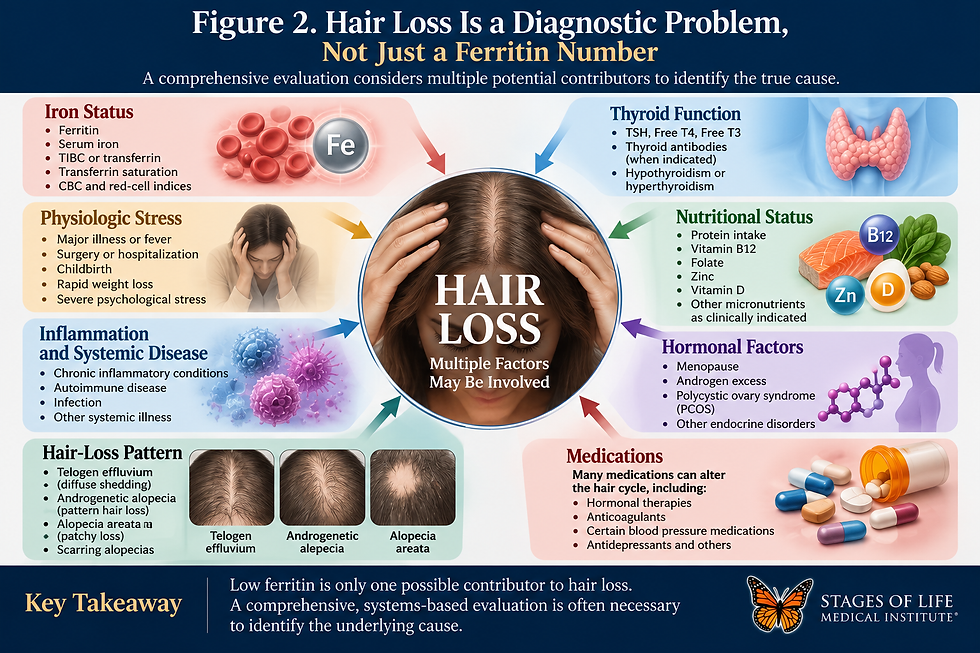
As illustrated in Figure 2, iron contributes to several biological processes necessary for normal hair follicle function. Although low ferritin may be associated with increased hair shedding, particularly telogen effluvium, there is insufficient evidence that raising ferritin above an arbitrary threshold consistently restores hair growth.
Hair loss is one of the more controversial clinical situations involving ferritin. Hair follicles contain rapidly dividing cells and require adequate nutrients, oxygen delivery, and cellular energy production. Because iron participates in these processes, researchers have investigated whether reduced iron stores contribute to excessive hair shedding.
One condition of particular interest is telogen effluvium, a form of diffuse hair shedding that can develop after physiological stress, illness, nutritional deficiency, or hormonal changes.
Several observational studies have found lower average ferritin concentrations among women experiencing nonscarring hair loss.³ However, other investigations have failed to establish a consistent association between low ferritin and hair loss.⁴ The distinction is important: an association does not prove that increasing ferritin will restore hair growth.
Should Ferritin Be Increased to 50 or 70 for Hair Growth?
Some clinicians recommend achieving ferritin concentrations above 40, 50, or even 70 ng/mL in patients experiencing hair loss. However, these proposed targets have not been validated by sufficiently rigorous clinical trials.
There is no universally established ferritin concentration that guarantees normal hair growth.
A patient with ferritin of 25 ng/mL may have genuinely reduced iron stores, but that does not establish iron deficiency as the cause of hair loss.
Likewise, increasing ferritin from 35 to 75 ng/mL does not guarantee improved hair density. Hair loss can also result from thyroid dysfunction, androgenetic alopecia, medications, illness, inadequate protein intake, and other nutritional or hormonal disturbances.
When Might Iron Supplementation Help?
Iron replacement is most defensible when laboratory findings establish genuine iron deficiency. For a patient with low ferritin and diffuse hair shedding, the physician should evaluate the pattern of hair loss, hemoglobin, transferrin saturation, inflammatory status, and potential causes of iron depletion. Correcting iron deficiency is appropriate even when hemoglobin remains normal in selected symptomatic patients. However, the evidence that iron supplementation independently reverses hair loss remains limited.⁵
The goal should be correcting an established deficiency—not artificially increasing ferritin to an arbitrary cosmetic target.
Why Ferritin May Remain Low Despite Taking Iron
Several conditions can interfere with successful iron replacement.
1. Continued blood loss
Chronic gastrointestinal bleeding, heavy menstrual bleeding, or other sources of blood loss may exceed the amount of iron absorbed.
2. Poor intestinal absorption
Celiac disease, prior gastrointestinal surgery, and other intestinal disorders can impair iron absorption.
3. Inflammation and increased hepcidin
Chronic inflammation may reduce intestinal iron uptake and limit the release of stored iron.
4. Medication and dietary interactions
Acid-suppressing medications, calcium supplements, tea, and coffee may interfere with iron absorption under certain circumstances.
5. Gastrointestinal intolerance
Constipation, nausea, abdominal discomfort, and diarrhea can reduce adherence to treatment.
When ferritin fails to improve, increasing the dose without investigating these factors may accomplish little.


Can Taking Iron Be Harmful?
Although iron is essential, unnecessary supplementation is not without risk. The most common adverse effects of oral ferrous sulfate are gastrointestinal, including constipation, nausea, abdominal discomfort, and diarrhea. Excessive iron accumulation can also be problematic in susceptible individuals, particularly those with hereditary hemochromatosis or other iron-loading disorders. Iron participates in oxidation-reduction reactions that can generate reactive oxygen species.
However, these concerns should not discourage appropriate treatment of confirmed deficiency. The objective is to restore adequate iron stores without unnecessary or prolonged supplementation.
What Your Doctor May Evaluate Before Recommending Iron Therapy
A comprehensive evaluation may include:
Complete blood count, including hemoglobin and red-cell indices
Serum ferritin
Serum iron and total iron-binding capacity
Transferrin saturation
C-reactive protein when inflammation is suspected
Investigation for gastrointestinal blood loss or malabsorption when indicated
In adult men and postmenopausal women with confirmed iron-deficiency anemia, gastrointestinal evaluation is particularly important.²
Simply correcting the laboratory abnormality may delay recognition of a more serious underlying disorder.
Frequently Asked Questions
Will ferrous sulfate increase ferritin if my hemoglobin is normal?
Yes. If iron stores are depleted and intestinal absorption is adequate, ferritin may increase even without anemia. Whether treatment is warranted depends on the clinical circumstances.
Is ferrous sulfate better than other iron supplements?
Ferrous sulfate is inexpensive and effective. Other formulations may be better tolerated by some patients, but they have not consistently demonstrated superior clinical effectiveness.
Should iron be taken every day?
Once-daily or alternate-day administration may be appropriate. The optimal schedule depends on the severity of deficiency, tolerance, and response.
Does vitamin C improve iron absorption?
Vitamin C can enhance nonheme iron absorption. Although the American Gastroenterological Association recommends adding vitamin C, clinical trials have not consistently shown that routine supplementation improves treatment outcomes.
Can low ferritin cause hair loss?
Low iron stores may contribute to hair shedding in some individuals. However, the association is inconsistent, and correcting ferritin does not guarantee hair regrowth.
Should ferritin be raised above 70 for healthier hair?
There is insufficient evidence to recommend a universal ferritin target of 70 ng/mL for hair growth.
Can ferritin be normal while iron availability is inadequate?
Yes. Inflammation can elevate ferritin while limiting iron availability. Transferrin saturation and the overall clinical picture help clarify the diagnosis.
Should everyone with ferritin below 50 take iron?
No. Ferritin below 50 ng/mL may justify further evaluation, but treatment should consider symptoms, hemoglobin, transferrin saturation, inflammation, and the cause of reduced iron stores.
Bottom Line
Ferrous sulfate can increase ferritin and is an effective treatment for many patients with documented iron deficiency. However, ferritin is a marker of iron storage, not an independent therapeutic objective. This distinction is particularly important in patients with normal hemoglobin or unexplained hair loss. Although iron deficiency may contribute to hair shedding, there is insufficient evidence to support raising ferritin to an arbitrary number solely to stimulate hair growth.
The most important question is not simply, "How can I raise my ferritin?" It is, "Why is my ferritin low, and will correcting it improve my health?"
Continue Your Journey to Better Health
At Stages of Life Medical Institute, we emphasize understanding the underlying mechanisms of disease rather than treating isolated laboratory values.
Iron metabolism connects with inflammation, mitochondrial energy production, gastrointestinal function, and overall metabolic health.
Related topics in our medical education library include:
Low Ferritin and Hair Loss: Understanding why ferritin can be within the laboratory reference range yet deserve further evaluation.
Insulin Resistance: How metabolic dysfunction influences inflammation and overall health.
Metabolic Syndrome: Understanding the relationship between metabolic health and chronic disease.
Subclinical Glycine Insufficiency: The importance of amino acids in cellular metabolism and tissue maintenance.
Fasting Insulin Versus Fasting Glucose: Why interpreting laboratory results requires more than relying on conventional reference ranges.
Publication note: Exact titles and live URLs should be verified before these are converted into website hyperlinks.
Become a Patient
At Stages of Life Medical Institute, we believe laboratory findings should always be interpreted in the context of the whole patient.
Our approach emphasizes individualized evaluation, thoughtful laboratory interpretation, and evidence-informed treatment.
Stages of Life Medical Institute
1917 Boothe Circle
Longwood, Florida 32750
Telephone: 407-679-3337
References
DeLoughery TG, Jackson CS, Ko CW, Rockey DC. AGA Clinical Practice Update on Management of Iron Deficiency Anemia: Expert Review. Clin Gastroenterol Hepatol. 2024;22(8):1575–1583.PubMed — PMID 38864796
Ko CW, Siddique SM, Patel A, et al. AGA Clinical Practice Guidelines on the Gastrointestinal Evaluation of Iron Deficiency Anemia. Gastroenterology. 2020;159(3):1085–1094.PubMed — PMID 32810434
Gude D, et al. Iron Deficiency and Nonscarring Alopecia in Women: Systematic Review and Meta-Analysis. Skin Appendage Disord. 2022.PubMed search — article title
Sinclair R. There is no clear association between low serum ferritin and chronic diffuse telogen hair loss. Br J Dermatol. 2002;147(5):982–984.PubMed — PMID 12410711
Trost LB, Bergfeld WF, Calogeras E. The diagnosis and treatment of iron deficiency and its potential relationship to hair loss. J Am Acad Dermatol. 2006;54(5):824–844.PubMed — PMID 16635664
Medical Disclaimer
This article is intended for educational purposes and does not replace individualized medical evaluation, diagnosis, or treatment. Iron supplementation should be undertaken with appropriate clinical guidance, particularly when the cause of abnormal iron studies is uncertain.
© 2026 Stages of Life Medical Institute. All rights reserved.
The medical references cited in this article are provided for educational purposes only and are intended to support general scientific discussion. They are not a substitute for individualized medical advice, diagnosis, or treatment. Clinical decisions should always be made in consultation with a qualified healthcare professional who can account for a patient’s unique medical history, medications, and circumstances.


1917 Boothe Circle, Suite 171
Longwood, Florida 32750
Tel: 407-679-3337
Fax: 407-678-7246