


Your Ferritin May Be Low or “In Range”—But Is It Too Low for Healthy Hair?

Why Hair Loss Should Trigger Investigation, Not Automatic Iron Supplementation
Quick Look
Ferritin is one of our most useful measures of stored iron, but an “in-range” ferritin does not necessarily mean iron status is adequate for every patient. Iron stores can become depleted well before hemoglobin falls enough to produce anemia, and several studies have found lower ferritin concentrations in patients with diffuse hair shedding or telogen effluvium.1,2,5 At the same time, the evidence does not establish a single ferritin concentration that guarantees healthy hair growth.3,5,12
The important message is therefore not: “Your ferritin is low, so take iron.”
A low or low-normal ferritin in someone losing hair is a clue that deserves investigation. Find out why the iron stores are low before simply treating the laboratory number.

What Does Ferritin Actually Tell Us?
Ferritin is an iron-storage protein. Serum ferritin generally provides useful information about the body's iron reserves.
When ferritin is clearly low, iron deficiency becomes increasingly likely. Importantly, iron stores can decline before hemoglobin becomes abnormal. This condition—iron deficiency without anemia—is well recognized.1
Normal hemoglobin does not necessarily mean normal iron stores.
A patient may therefore have a normal CBC while already having substantially depleted iron reserves. Hair follicles are metabolically active structures with rapidly dividing matrix cells and a carefully regulated growth cycle. This provides a biologically plausible mechanism through which inadequate iron availability might influence hair cycling before overt anemia develops.
The Problem With the Words “Normal Range”
Laboratory reference intervals are generally statistical ranges derived from reference populations. They do not necessarily define the concentration at which every tissue functions optimally—or determine whether a particular laboratory value is clinically relevant in an individual patient.
Ferritin illustrates this problem particularly well. A laboratory may report a ferritin concentration near the bottom of its reference interval as “normal.” In a patient with diffuse hair shedding and other evidence suggesting depleted iron stores, however, that result may deserve further investigation. Interpretation also depends upon age, sex, clinical circumstances, inflammation and the remainder of the iron profile.6
Clinical Pearl
When evaluating hair loss, I am less interested in whether the computer placed a green checkmark beside the ferritin than I am in answering three questions: Is iron actually depleted? Why is it depleted? And is iron deficiency truly contributing to this patient's hair loss? Those questions are considerably more useful than simply asking whether ferritin is technically “in range.”
What Does the Hair-Loss Research Show?
There is evidence connecting lower ferritin with some forms of diffuse hair shedding, particularly telogen effluvium—but the literature is not completely consistent. One study of women with diffuse telogen hair loss reported a mean ferritin concentration of approximately 16 ng/mL, compared with approximately 60 ng/mL among controls. In that study, ferritin concentrations ≤30 ng/mL were strongly associated with telogen hair loss.2Other studies have also reported associations between decreased ferritin and alopecia.4
But an important controlled study from the Duke University Hair Disorders Clinic provides a useful counterpoint. Investigators found that iron deficiency was common among women generally but was not significantly more prevalent among women with female-pattern hair loss or chronic telogen effluvium than among controls, whether ferritin ≤15 or ≤40 μg/L was used to define iron deficiency.
The authors also emphasized that whether correcting iron deficiency improves hair loss remained uncertain.3
That is precisely why I would not treat hair loss by chasing an arbitrary ferritin target.
There Is No Proven “Magic Ferritin Number” for Hair Growth
Patients searching online may encounter recommendations suggesting that ferritin must exceed 40, 50, 70 or even 100 ng/mL for hair to grow normally.
The available evidence does not establish a universal ferritin target for hair growth. Ferritin around 30 ng/mL or below may certainly raise concern for depleted iron stores in the appropriate clinical context, and some hair-loss studies have demonstrated associations around this range. But demonstrating an association is very different from proving that deliberately raising ferritin to a particular higher concentration will restore hair.2,5
A diagnostic threshold for iron deficiency is not automatically a therapeutic target for hair growth.
Why I Don't Automatically Reach for an Iron Supplement
When ferritin is low, my next question is: Why?
Simply prescribing iron can bypass the more important diagnosis. Potential causes of depleted iron stores include:
Menstrual blood loss
Occult gastrointestinal blood loss
Frequent blood donation
Inadequate dietary iron
Restrictive diets or rapid weight loss
Malabsorption
Celiac disease
Inflammatory bowel disease
Bariatric or other gastrointestinal surgery
Pregnancy and increased physiologic requirements
Other gastrointestinal disease
In adults—particularly men and postmenopausal women—otherwise unexplained iron deficiency may require evaluation for gastrointestinal blood loss rather than simply indefinite iron replacement.7
Oral iron is also not physiologically neutral. Gastrointestinal adverse effects are common, adherence may be poor, and supplementation is difficult to justify when iron deficiency has not actually been established.7
When genuine iron deficiency is demonstrated, iron replacement may certainly be appropriate. But replacement and investigation are not competing strategies. The deficiency should be treated when appropriate—and its cause should be understood.
Treat the patient and the cause—not the ferritin number.
Ferritin Can Fool Us in the Opposite Direction
Ferritin is an acute-phase reactant. Inflammation can increase serum ferritin independently of available iron stores. Consequently, a ferritin result that appears reassuring—or is even elevated—does not invariably exclude iron deficiency. This becomes particularly important in chronic inflammatory conditions. In these circumstances, transferrin saturation and the broader clinical and laboratory picture become increasingly important.14
Ferritin result | What it may mean |
Clearly low | Strong evidence supporting depleted iron stores |
Low-normal | May deserve further investigation in the appropriate clinical context |
Normal | Does not always exclude iron deficiency |
Elevated | May reflect inflammation and does not necessarily mean abundant available iron |
This is why ferritin should rarely be interpreted in isolation.
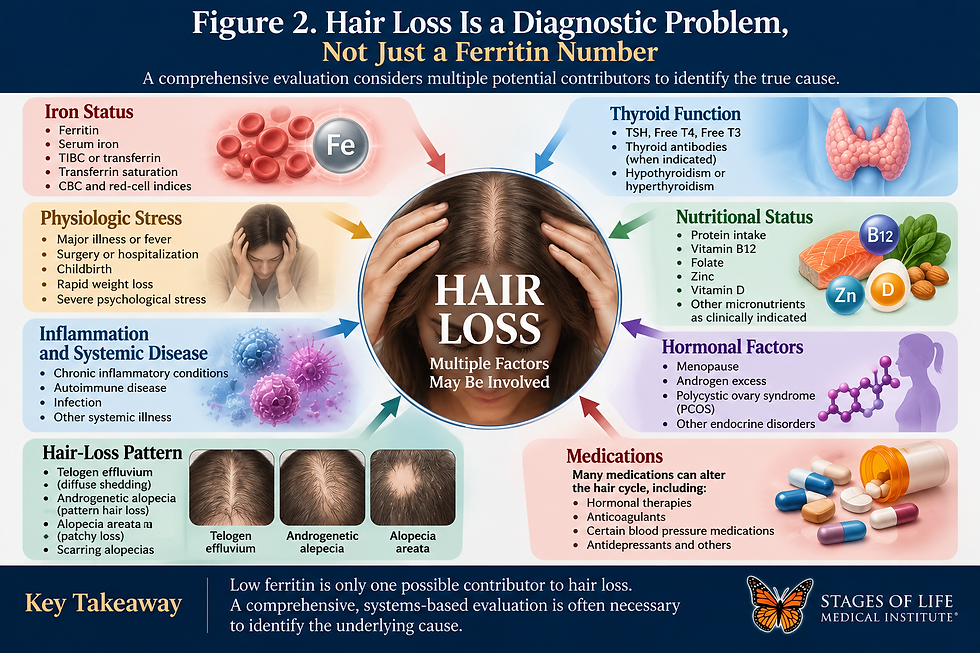
What Your Doctor May Evaluate Before Blaming Ferritin for Hair Loss
Iron physiology: Ferritin, serum iron, TIBC or transferrin, transferrin saturation, CBC and red-cell indices can provide considerably more information than ferritin alone.
Inflammation: CRP or other appropriate markers may help when inflammation could make ferritin difficult to interpret.
Thyroid function: Thyroid dysfunction is an important potentially reversible contributor to diffuse hair changes.
Nutritional status: Protein intake and, when clinically indicated, vitamin B12, folate, zinc, vitamin D and other nutritional factors may deserve consideration.
Hormonal factors: Menopause, androgen excess, polycystic ovary syndrome and other endocrine abnormalities may contribute in the appropriate patient.
Recent physiologic stress: Major illness, fever, surgery, hospitalization, childbirth, substantial weight loss or severe psychological stress may trigger telogen effluvium weeks to months later.9,10
Medications: Numerous medications can alter the normal hair cycle.
What type of hair loss is actually occurring? Telogen effluvium, androgenetic alopecia, alopecia areata and scarring alopecias are fundamentally different conditions. Iron studies cannot substitute for an appropriate history and examination of the scalp and hair.
Iron Deficiency Without Anemia
Patients commonly tell me: “My hemoglobin is normal, so I can't be iron deficient.”
That conclusion is incorrect. Stored iron can decline first. Only later may iron availability become sufficiently impaired to restrict erythropoiesis and ultimately reduce hemoglobin.
Adequate iron stores
↓
Declining ferritin
↓
Iron deficiency without anemia
↓
Iron-restricted red-cell production
↓
Iron-deficiency anemia
A normal hemoglobin therefore does not automatically exclude depleted iron stores.1

FAQ
Can low ferritin cause hair loss?
Iron deficiency is associated with some forms of diffuse hair shedding, particularly telogen effluvium. But low ferritin is not the explanation for every patient with hair loss, and association does not prove causation in every individual.2,3
What ferritin level is best for hair growth?
There is no universally established evidence-based ferritin target for hair growth. Published studies have used different thresholds, and the concentration used to help identify iron deficiency should not automatically be interpreted as a hair-growth treatment target.5,12
Can ferritin be “normal” and still deserve investigation?
Yes. A low-normal ferritin may be meaningful when interpreted alongside symptoms, transferrin saturation, CBC indices, inflammation, diet, sources of blood loss and the patient's overall history.
Should I take iron if my ferritin is low?
Not automatically. The first steps are establishing whether clinically meaningful iron deficiency is actually present and investigating why the stores are depleted. Iron replacement may be appropriate for established deficiency, but the underlying cause should also be addressed.
Can I have iron deficiency without anemia?
Yes. Iron stores may become depleted before hemoglobin becomes abnormal.1
How quickly does hair recover after correcting an underlying problem?
Hair follicles operate on a slow biological cycle. Even after a trigger has been corrected, visible improvement may take months. Persistent, progressive, patchy or scarring hair loss deserves reassessment rather than repeated empiric supplementation.
Bottom Line
Ferritin deserves attention in patients with unexplained diffuse hair loss—but not because every low or low-normal ferritin should trigger automatic iron supplementation.
The more useful question is: Why are the iron stores low?
A ferritin concentration near the lower end of a laboratory reference interval may represent clinically relevant iron depletion in the appropriate patient. Conversely, inflammation can elevate ferritin and sometimes make iron status more difficult to interpret. And even when iron deficiency is present, it may represent only one piece of the hair-loss puzzle.
The goal should therefore be to identify the type of hair loss, establish whether iron deficiency truly exists, investigate its cause, evaluate competing contributors and then determine whether iron replacement is actually appropriate.
Ferritin is a clue. It is not the diagnosis—and it is certainly not an automatic prescription.
Continue Your Journey to Better Health
Hair loss rarely has a single cause. Iron availability is only one part of a larger physiologic picture involving thyroid function, nutrition, inflammation, hormonal signaling, metabolic health, medications and recent physiologic stress. These related Stages of Life Medical Institute articles illustrate why a systems-based, diagnosis-first approach can be more useful than treating an isolated laboratory result.
Hair thinning can accompany hypothyroidism, yet a single TSH result may not explain every patient's symptoms. This article explores broader thyroid evaluation when fatigue, cold intolerance, weight changes or hair loss persist despite apparently reassuring routine laboratory results.
Autoimmune thyroid disease belongs in the differential diagnosis of unexplained hair thinning, particularly when hair changes occur alongside fatigue, dry skin, weight changes or menstrual symptoms. This article examines thyroid antibodies, hormone testing, nutrition and inflammation in Hashimoto's disease.
Iron is not the only micronutrient relevant to hair and thyroid physiology. Iodine and selenium participate in thyroid-hormone production and metabolism, illustrating why nutritional evaluation should examine physiologic relationships rather than simply replacing one nutrient because its laboratory value appears low.
Vitamin D intersects with immune regulation and thyroid autoimmunity. For patients whose hair loss occurs alongside thyroid symptoms or autoimmune disease, this article provides a broader perspective on the relationship between micronutrient status and endocrine physiology.
Low iron stores may present with fatigue as well as hair complaints, but iron deficiency is only one possibility. This article explores other metabolic, endocrine, nutritional, sleep-related and inflammatory contributors when symptoms persist despite supposedly “normal” laboratory testing.
This article illustrates the other side of supplementation: more is not necessarily better. Selenium deficiency may matter, but excessive selenium can itself produce adverse effects—including hair loss—reinforcing the same principle applied to iron: establish the problem before automatically supplementing it.
Become a Patient
At Stages of Life Medical Institute, unexplained hair loss is approached as a diagnostic problem rather than simply a cosmetic symptom—or an invitation to prescribe another supplement.
When ferritin is low or near the lower end of its reference interval, our first question is not simply: “How do we raise the ferritin?”
We want to understand: Is iron deficiency actually present? Why are the iron stores depleted? Is iron deficiency contributing to the hair loss? And what other physiologic factors might be involved?
A comprehensive evaluation may examine iron physiology, CBC indices, thyroid function, nutritional status, inflammation, hormones, medications, gastrointestinal health, sources of blood loss, metabolic health, recent illness or physiologic stress, and the pattern of hair loss itself.
The objective is to identify and address the cause, rather than simply making a laboratory number look better.
Medical Disclaimer
This article is intended for education and does not substitute for individualized medical diagnosis or treatment. Iron supplementation can be inappropriate in some circumstances and should be considered in the context of laboratory findings, medical history, medications, diet, gastrointestinal health, possible sources of blood loss and the underlying cause of iron depletion.
Our Systems-Based Philosophy
At Stages of Life Medical Institute, an abnormal—or deceptively “normal”—laboratory result is not interpreted in isolation. We evaluate how hematologic, nutritional, gastrointestinal, endocrine, inflammatory, metabolic and lifestyle factors interact so that treatment can address underlying physiology rather than simply changing a laboratory number.
Ferritin is a clue. The objective is not merely to change the number—it is to understand the physiology behind it.
References
1. Al-Naseem A, et al. Iron deficiency without anaemia: a diagnosis that matters. Clin Med (Lond). 2021;21:107–113. PubMed
2. Moeinvaziri M, et al. Iron status in diffuse telogen hair loss among women. Acta Dermatovenerol Croat. 2009. PubMed
3. Olsen EA, et al. Iron deficiency in female pattern hair loss, chronic telogen effluvium, and control groups. J Am Acad Dermatol. 2010. PubMed
4. Kantor J, et al. Decreased serum ferritin is associated with alopecia in women. J Invest Dermatol. 2003. PubMed
5. Trost LB, Bergfeld WF, Calogeras E. The diagnosis and treatment of iron deficiency and its potential relationship to hair loss. J Am Acad Dermatol. 2006. PubMed
6. Fletcher A, et al. Guideline for the laboratory diagnosis of iron deficiency in adults (excluding pregnancy) and children. Br J Haematol. 2022;196:523–529. PubMed
7. Latimer K, Baci G, Layne M. Iron Deficiency Anemia: Evaluation and Management. Am Fam Physician. 2025;112:538–545. PubMed
8. Thamotharan N, et al. Assessment of Serum Ferritin Levels in Female Patients With Telogen Effluvium. Cureus. 2025;17:e100249. PubMed
9. Shrivastava SB. Diffuse hair loss in an adult female: approach to diagnosis and management. Indian J Dermatol Venereol Leprol. 2009. PubMed
10. Grover C, Khurana A. Telogen effluvium. Indian J Dermatol Venereol Leprol. 2013;79:591–603. PubMed
11. Daunton A, et al. Chronic Telogen Effluvium: Is it a Distinct Condition? A Systematic Review. Am J Clin Dermatol. 2023. PubMed
12. Serum Ferritin Levels: A Clinical Guide in Patients With Hair Loss. Cutis. 2023. PubMed
13. Association between Serum Trace Elements and Telogen Effluvium: A Systematic Review and Meta-Analysis. 2026. PubMed
14. Cappellini MD, et al. Iron deficiency across chronic inflammatory conditions: International expert opinion on definition, diagnosis, and management. Am J Hematol. 2017. PubMed
© 2026 Stages of Life Medical Institute
The medical references cited in this article are provided for educational purposes only and are intended to support general scientific discussion. They are not a substitute for individualized medical advice, diagnosis, or treatment. Clinical decisions should always be made in consultation with a qualified healthcare professional who can account for a patient’s unique medical history, medications, and circumstances.


1917 Boothe Circle, Suite 171
Longwood, Florida 32750
Tel: 407-679-3337
Fax: 407-678-7246


.webp)