


Selenium, Thyroid Autoimmunity, and Hypothyroidism. Why This Trace Mineral Matters for Thyroid Health

Introduction
Among all organs in the body, the thyroid gland contains one of the highest concentrations of selenium per gram of tissue.¹ This is not accidental. Selenium is required for the function of several enzymes that regulate thyroid hormone metabolism and protect the thyroid gland from oxidative injury.
Increasing evidence suggests that selenium deficiency may contribute to autoimmune thyroid disease and impaired thyroid hormone activation, while appropriate selenium intake may help stabilize thyroid function and reduce autoimmune activity in some patients.
Because thyroid disorders—particularly autoimmune thyroiditis and hypothyroidism—are common, understanding selenium nutrition is clinically important.
This article explores:
• why the thyroid requires selenium
• how selenium influences autoimmune thyroid disease
• where selenium occurs in food and water
• safe supplementation levels
Why the Thyroid Requires Selenium
The thyroid gland produces hormones through a biochemical process that generates hydrogen peroxide, a powerful oxidizing molecule required for thyroid hormone synthesis.
While necessary for hormone production, hydrogen peroxide also creates oxidative stress within thyroid cells.
To protect itself, the thyroid relies on selenium-dependent antioxidant enzymes known as selenoproteins. These enzymes include:
Glutathione peroxidase – neutralizes hydrogen peroxide
Thioredoxin reductase – maintains redox balance in thyroid cells
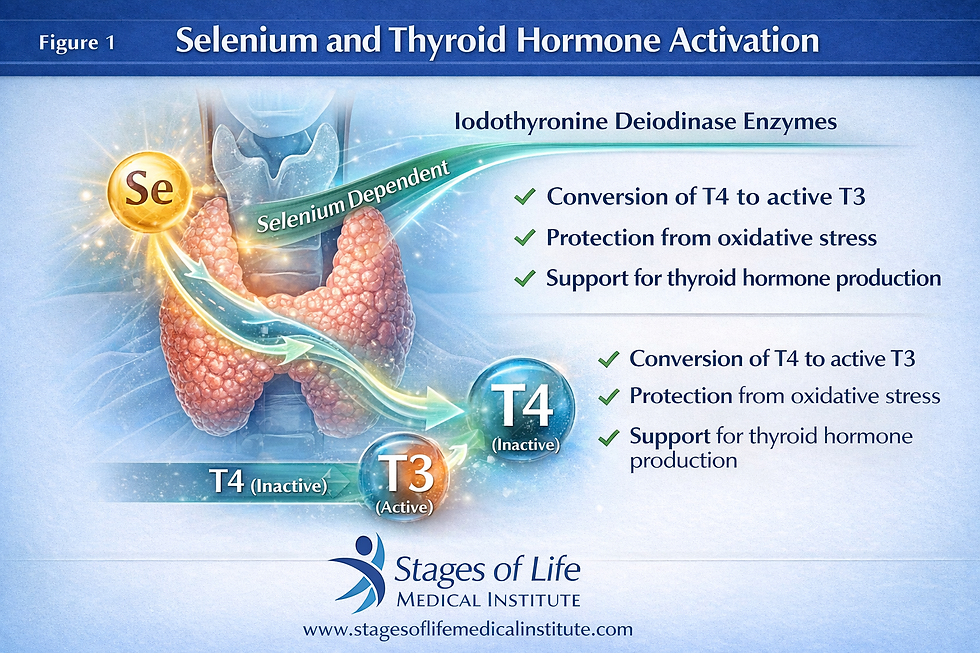
Iodothyronine deiodinases – convert inactive thyroid hormone (T4) into the active hormone (T3)
Without adequate selenium, the thyroid becomes more vulnerable to oxidative damage, inflammation, and immune dysregulation.¹
Selenium and Thyroid Hormone Activation
Most thyroid hormone produced by the thyroid gland is thyroxine (T4). However, T4 is largely inactive and must be converted into triiodothyronine (T3) in peripheral tissues.
This conversion is carried out by iodothyronine deiodinase enzymes, which are selenium dependent.
When selenium levels are inadequate:
• T4-to-T3 conversion may decline
• metabolic activity slows
• hypothyroid symptoms may develop despite “normal” T4 levels
This relationship illustrates why selenium status can influence thyroid function even when iodine intake is adequate.
Selenium and Autoimmune Thyroiditis
The most common cause of hypothyroidism in developed countries is autoimmune thyroiditis, most often referred to as Hashimoto’s disease.
In this condition the immune system produces antibodies against thyroid tissue, particularly:
• thyroid peroxidase antibodies (TPOAb)
• thyroglobulin antibodies
Several clinical studies have demonstrated that selenium supplementation may reduce thyroid antibody levels, particularly TPO antibodies.²
Proposed mechanisms include:
• reduced oxidative stress in thyroid cells
• improved immune regulation
• decreased inflammatory cytokine signaling
Although selenium is not a cure for autoimmune thyroid disease, it may moderate the intensity of autoimmune activity in some patients.

Selenium and Hypothyroidism
Selenium deficiency may contribute to hypothyroidism through several mechanisms:
Reduced T4 to T3 Conversion
Without selenium-dependent deiodinase enzymes, active thyroid hormone production may
decline.
Increased Oxidative Injury
Insufficient selenium weakens antioxidant defenses within thyroid tissue.
Immune Dysregulation
Low selenium status has been associated with increased autoimmune activity in thyroid disease.
For these reasons, selenium status may be worth considering in patients with:
• autoimmune thyroiditis• persistent hypothyroid symptoms• elevated thyroid antibodies
Where Do We Get Selenium?
Selenium enters the food chain through soil and groundwater. Plants absorb selenium from soil, and animals obtain selenium by consuming those plants.
Because soil selenium concentrations vary widely, selenium intake differs between geographic regions.
Foods Rich in Selenium
Food | Approximate Selenium Content |
Brazil nuts | 68–90 mcg per nut |
Tuna | ~90 mcg per 3 oz |
Sardines | ~45 mcg per 3 oz |
Eggs | ~15 mcg each |
Chicken | ~25 mcg per 3 oz |
Sunflower seeds | ~20 mcg per ounce |
Mushrooms | ~12 mcg per serving |
Brazil nuts are particularly concentrated sources of selenium, although levels vary depending on soil composition.
Selenium in Drinking Water
Selenium can also occur in groundwater, particularly in regions with selenium-rich soils.
However, the contribution of drinking water to total selenium intake is usually small compared with dietary sources such as seafood, eggs, poultry, and nuts.
Selenium Supplementation and Selenomethionine for Autoimmune Thyroiditis
When selenium supplementation is recommended, the chemical form of selenium matters.
Common supplemental forms include:
• sodium selenite
• sodium selenate
• selenium-enriched yeast
• selenomethionine
Among these, selenomethionine is often preferred because it is well absorbed and incorporated into body proteins, creating a storage pool that can later be used for the synthesis of selenoproteins.³
Many clinical trials examining selenium supplementation in autoimmune thyroiditis have used approximately 200 mcg of selenomethionine daily.²
Safe Selenium Dosage
Because selenium is required in small amounts, both deficiency and excess can cause problems.
Recommended Dietary Allowance
Adults:
55 micrograms per day

Typical Supplemental Range for thyroid support:
100–200 micrograms daily
This range has been widely studied and appears safe for most individuals.
Upper Safe Intake Limit
The tolerable upper intake level established by the National Institutes of Health is:
400 micrograms per day
Excess selenium intake over long periods can lead to selenosis, which may cause:
• hair loss
• brittle nails
• gastrointestinal upset
• neurologic symptoms

Bottom Line
Selenium is an essential trace mineral that plays a central role in thyroid physiology.
Adequate selenium intake supports:
• conversion of T4 to active T3
• antioxidant protection of thyroid tissue
• modulation of autoimmune thyroid activity
Dietary sources such as seafood, eggs, poultry, and Brazil nuts can provide selenium, while supplementation with 100–200 mcg daily—often as selenomethionine—may support thyroid health when appropriate.
Become a Patient
If you are experiencing thyroid symptoms, autoimmune thyroid disease, or persistent fatigue despite normal laboratory results, a deeper integrative evaluation may help uncover contributing factors.
To learn more or schedule a consultation:
Stages of Life Medical Institutehttps://www.stagesoflifemedicalinstitute.com
References
Köhrle J. Selenium and the thyroid. Curr Opin Endocrinol Diabetes Obes. 2015;22(5):392-401.https://pubmed.ncbi.nlm.nih.gov/26200417/
Winther KH, et al. Selenium supplementation in autoimmune thyroiditis: systematic review and meta-analysis. Thyroid. 2017;27(3):334-343.https://pubmed.ncbi.nlm.nih.gov/27936973/
Rayman MP. Selenium and human health. Lancet. 2012;379:1256-1268.https://pubmed.ncbi.nlm.nih.gov/22424136/
Duntas LH. Selenium and thyroid disease. Clin Endocrinol. 2010;73:545-552.https://pubmed.ncbi.nlm.nih.gov/20550537/
Negro R, et al. Selenium supplementation in patients with autoimmune thyroiditis. J Clin Endocrinol Metab. 2007;92:1263-1268.https://pubmed.ncbi.nlm.nih.gov/17299079/
Rayman MP. Selenium and human health. Lancet. 2012;379(9822):1256-1268.https://pubmed.ncbi.nlm.nih.gov/22424136/Winther
KH, et al. Selenium supplementation in autoimmune thyroiditis: a systematic review and meta-analysis. Thyroid. 2017;27(3):334-343.https://pubmed.ncbi.nlm.nih.gov/27936973/
The medical references cited in this article are provided for educational purposes only and are intended to support general scientific discussion. They are not a substitute for individualized medical advice, diagnosis, or treatment. Clinical decisions should always be made in consultation with a qualified healthcare professional who can account for a patient’s unique medical history, medications, and circumstances.


1917 Boothe Circle, Suite 171
Longwood, Florida 32750
Tel: 407-679-3337
Fax: 407-678-7246


.webp)