


Your Fasting Glucose Is Normal—but Is Your Insulin?

Why Fasting Insulin May Reveal Metabolic Trouble Earlier Than Fasting Glucose
Quick Look
A normal fasting glucose does not necessarily mean normal insulin metabolism. In the early stages of insulin resistance, the pancreas may compensate by producing substantially more insulin, keeping glucose deceptively normal. Studies using direct measures of insulin sensitivity have demonstrated insulin resistance and hyperinsulinemia in people who still have normal glucose tolerance.¹²
That makes fasting insulin particularly useful as an early metabolic clue. It does not replace fasting glucose, hemoglobin A1c, or an oral glucose tolerance test—but it may reveal how hard the body is working to keep glucose normal.
The Normal Glucose Trap
Most routine metabolic testing begins with fasting glucose. That makes sense. Glucose is inexpensive, standardized, and clinically important.
Current American Diabetes Association criteria define prediabetes as fasting plasma glucose 100–125 mg/dL and diabetes as ≥126 mg/dL, with hemoglobin A1c and oral glucose tolerance testing providing additional diagnostic pathways.³ By the time you find yourself with a glucose over 90, you are well on your way to pre-diabetes and Insulin Resistance.
But fasting glucose answers only one question:
How much glucose is circulating in the blood right now?
It does not tell us how much insulin was required to keep it there.
That distinction can be enormously important.
Imagine two patients:
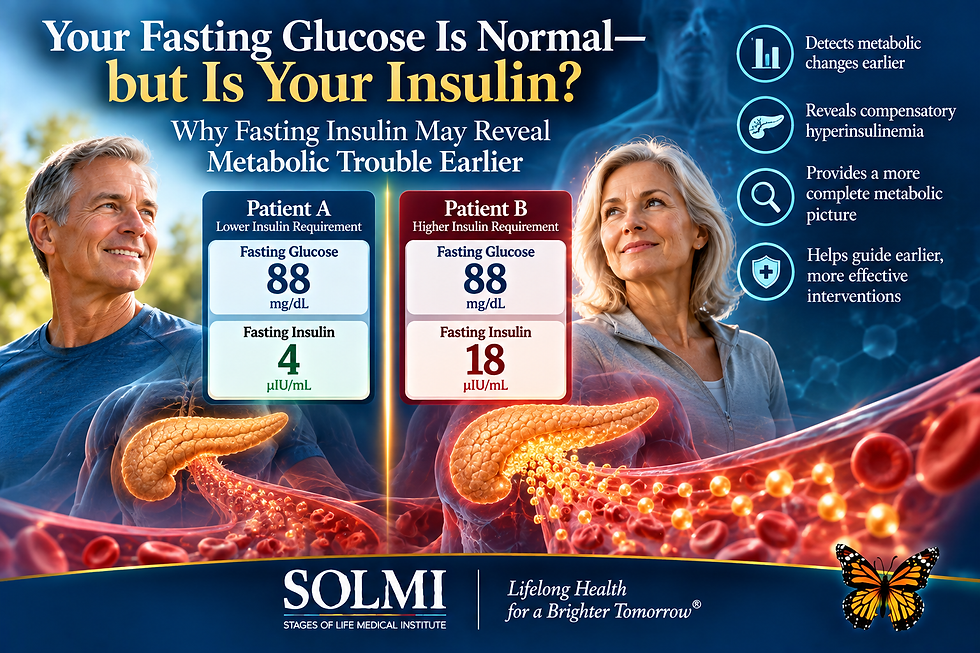
Patient A | Patient B | |
Fasting glucose | 88 mg/dL | 88 mg/dL |
Fasting insulin | 4 µIU/mL | 18 µIU/mL |
Glucose result | Normal | Normal |
Metabolic interpretation | Low insulin requirement | Possible compensatory hyperinsulinemia |
Both patients have identical fasting glucose.
But metabolically, they may be very different.
Patient B may require considerably more insulin to maintain the same glucose concentration.


Insulin Resistance Often Begins Before Glucose Rises
Insulin allows muscle, liver, and other tissues to respond appropriately to circulating nutrients.
When those tissues become resistant to insulin, the pancreas initially compensates by secreting more.
Classic metabolic studies demonstrated that insulin sensitivity varies dramatically even among people with normal glucose tolerance. Individuals who were more insulin resistant secreted substantially more insulin while maintaining similar glucose responses.¹
In other words, the pancreas can conceal insulin resistance for a surprisingly long time.
Glucose may therefore remain reassuring while insulin is already telling a different story.

Why Fasting Insulin Can Add Information
Fasting glucose largely reflects the result of glucose regulation.
Fasting insulin provides information about the effort required to produce that result.
This distinction is particularly useful when a patient has other signs associated with insulin resistance, including:
Increasing waist circumference
Elevated triglycerides
Low HDL cholesterol
Fatty liver
Hypertension
Weight gain
A strong family history of type 2 diabetes
Polycystic ovary syndrome
Increasing A1c despite “normal” fasting glucose
The ADA recognizes several of these as conditions associated with insulin resistance and increased diabetes risk.³
Clinical Pearl
A fasting glucose of 90 mg/dL does not tell me whether the pancreas needed 4 units of insulin or 20 units of insulin to achieve it.
That is why I prefer to look at glucose and insulin together when evaluating metabolic physiology.
The question is not simply:
“Is the glucose normal?”
It is also:
“How much insulin did the body need to keep it normal?”
What About HOMA-IR?
Fasting insulin becomes more informative when interpreted together with fasting glucose.
One commonly used estimate is the Homeostatic Model Assessment of Insulin Resistance, or HOMA-IR.⁴
Using conventional U.S. units:
HOMA-IR = fasting insulin (µIU/mL) × fasting glucose (mg/dL) ÷ 405
The original HOMA model correlated reasonably well with more sophisticated measures of insulin resistance, including the euglycemic clamp.⁴
But HOMA-IR should not be treated like cholesterol, where one universal number defines disease. Results vary with population, laboratory methodology, age, adiposity, and especially the insulin assay used.
An Important Limitation: Insulin Testing Is Not Yet Fully Standardized
This deserves emphasis.
Fasting insulin is not currently an ADA diagnostic criterion for prediabetes or diabetes. Diagnosis remains based on glucose, A1c, and/or oral glucose tolerance testing.³ Furthermore, insulin assays remain less harmonized between laboratories than glucose assays. ADA-associated laboratory guidance has specifically identified lack of insulin-assay standardization as an obstacle to universal clinical cutoffs.⁵⁶
Therefore, fasting insulin should be interpreted as part of the entire metabolic picture—not as an isolated diagnostic number.
This is also why trends measured by the same laboratory and assay can sometimes be more informative than comparing a single result with an internet-derived “optimal” range.
Does Higher Insulin Matter Beyond Diabetes?
Possibly—and this is where the literature becomes particularly interesting. Hyperinsulinemia and insulin resistance have been associated with hypertension, dyslipidemia, coronary disease, and other components of metabolic syndrome.⁷
A meta-analysis of prospective cohorts found higher fasting insulin associated with increased subsequent risk of hypertension and coronary heart disease, although observational associations cannot establish that insulin itself caused those outcomes.⁸
Another meta-analysis found that HOMA-IR was associated with all-cause mortality among adults without diabetes, while fasting insulin alone produced a weaker and less consistent association.⁹
That distinction reinforces an important point:
Insulin is most useful when interpreted as part of metabolic physiology—not as a stand-alone risk marker.
What Your Doctor May Evaluate Before Interpreting Fasting Insulin
At Stages of Life Medical Institute, metabolic assessment may extend beyond one glucose measurement.
Depending upon the individual, evaluation may include fasting glucose, fasting insulin, hemoglobin A1c, triglycerides and HDL, waist circumference, blood pressure, liver enzymes, body composition, medication effects, family history, sleep, physical activity, and sometimes oral glucose tolerance or post-meal glucose assessment.
The purpose is not simply to determine whether someone has crossed the threshold into diabetes.
The more useful question may be:
Is metabolic dysfunction developing before diabetes appears?

FAQ
Can I have insulin resistance with a normal fasting glucose? Yes. Insulin resistance can be accompanied by compensatory hyperinsulinemia that maintains normal glucose for a period of time.¹²
Does a high fasting insulin diagnose diabetes? No. Current diabetes diagnostic criteria use fasting glucose, A1c, oral glucose tolerance testing, or appropriately interpreted random glucose—not fasting insulin.³
Is there one ideal fasting insulin level? No universally accepted clinical cutoff exists. Insulin assays are insufficiently standardized for a single number to be applied reliably across all laboratories and populations.⁵⁶
Is fasting insulin better than fasting glucose? They answer different questions. Glucose remains essential for diagnosing dysglycemia. Insulin may provide additional information about the compensatory physiology occurring before glucose becomes abnormal.
Should HOMA-IR be used alone? No. It is an estimate of insulin resistance and should be interpreted with clinical findings and other metabolic markers.⁴
Bottom Line
Fasting glucose tells us where the glucose is.
Fasting insulin may help tell us how hard the body is working to keep it there.
That is why a normal fasting glucose should not automatically be interpreted as proof of optimal metabolic health.
During early insulin resistance, the pancreas may compensate by producing progressively more insulin, maintaining apparently normal glucose until that compensation eventually becomes inadequate.
The most useful approach is therefore not fasting insulin instead of fasting glucose.
It is fasting insulin together with glucose, A1c, lipids, body composition, blood pressure, clinical history, and other appropriate metabolic measurements.
Early metabolic disease is easier to address when we look for the physiology that precedes diabetes rather than waiting for glucose to announce that compensation has begun to fail.
Continue Your Journey to Better Health
Insulin resistance develops across multiple organ systems rather than as an isolated blood-sugar problem. These related Stages of Life Medical Institute articles explore the progression from early hyperinsulinemia to metabolic syndrome and overt dysglycemia.
Become a Patient
At Stages of Life Medical Institute, our approach to metabolic health extends beyond asking whether a laboratory value falls inside a reference range. We evaluate the interacting systems that influence insulin sensitivity, glucose regulation, body composition, cardiovascular risk, hormones, nutrition, sleep, and long-term health.
For patients concerned about insulin resistance, prediabetes, metabolic syndrome, or unexplained metabolic changes, comprehensive evaluation can help identify abnormalities while there is still an opportunity to intervene early.
Medical Disclaimer
This article is intended for education and does not substitute for individualized medical diagnosis or treatment. Laboratory values, medications, supplements, nutrition, and other interventions should be interpreted in the context of the individual's medical history, examination, medications, and overall risk profile.
Our Systems-Based Philosophy
At Stages of Life Medical Institute, laboratory abnormalities are not viewed in isolation. Our goal is to understand the physiologic relationships among metabolic, hormonal, cardiovascular, inflammatory, nutritional, and lifestyle factors so that treatment can address underlying dysfunction rather than simply reacting to a late-stage laboratory diagnosis.
References
Hollenbeck C, Reaven GM. Variations in insulin-stimulated glucose uptake in healthy individuals with normal glucose tolerance. J Clin Endocrinol Metab. 1987;64:1169–1173. PubMed PMID 3553221
Yang G, et al. Assessment of insulin resistance in subjects with normal glucose tolerance, hyperinsulinemia with normal blood glucose tolerance, impaired glucose tolerance, and newly diagnosed type 2 diabetes. J Diabetes Res. 2016;2016:9270768. PubMed PMID 26770991
American Diabetes Association Professional Practice Committee. Diagnosis and Classification of Diabetes: Standards of Care in Diabetes—2026. Diabetes Care. 2026;49(Suppl 1):S27–S49. PubMed PMID 41358893
Matthews DR, et al. Homeostasis model assessment: insulin resistance and beta-cell function from fasting plasma glucose and insulin concentrations in man. Diabetologia. 1985;28:412–419. PubMed PMID 3899825
Marcovina S, et al. Standardization of insulin immunoassays: report of the American Diabetes Association Workgroup. Clin Chem. 2007;53:711–716. PubMed PMID 17272483
Robbins DC, et al. Report of the American Diabetes Association's Task Force on standardization of the insulin assay. Diabetes. 1996;45:242–256. PubMed PMID 8549870
Reaven GM. Resistance to insulin-stimulated glucose uptake and hyperinsulinemia: role in non-insulin-dependent diabetes, high blood pressure, dyslipidemia and coronary heart disease. Diabete Metab. 1991;17:78–86. PubMed PMID 1936488
Xun P, et al. Fasting insulin concentrations and incidence of hypertension, stroke, and coronary heart disease: a meta-analysis of prospective cohort studies. Am J Clin Nutr. 2013. PubMed PMID 24132974
Zhang X, et al. Fasting insulin, insulin resistance, and risk of cardiovascular or all-cause mortality in non-diabetic adults: a meta-analysis. Biosci Rep. 2017;37:BSR20170947. PubMed PMID 28811358
Hu G, et al. Plasma insulin and cardiovascular mortality in non-diabetic European men and women: a meta-analysis of data from eleven prospective studies. Diabetologia. 2004. PubMed PMID 15241592
Ruige JB, et al. Insulin and risk of cardiovascular disease: a meta-analysis. Circulation. 1998;97:996–1001. PubMed PMID 9529268
Staten MA, et al. Insulin assay standardization: leading to measures of insulin sensitivity and secretion for practical clinical care. Diabetes Care. 2010;33:205–206. ADA/PMC full text
The medical references cited in this article are provided for educational purposes only and are intended to support general scientific discussion. They are not a substitute for individualized medical advice, diagnosis, or treatment. Clinical decisions should always be made in consultation with a qualified healthcare professional who can account for a patient’s unique medical history, medications, and circumstances.


1917 Boothe Circle, Suite 171
Longwood, Florida 32750
Tel: 407-679-3337
Fax: 407-678-7246


.webp)