Why Do My Eyes Twitch? Part 2 — Neurological Causes, Nutritional Deficiencies, and Treatment


Quick Look
Most eyelid twitching is harmless, but persistent or unusual spasms deserve closer attention. Certain neurological disorders, medications, and electrolyte disturbances can produce involuntary muscle movements. The pattern of twitching often provides more useful diagnostic information than laboratory testing alone. Understanding when to investigate—and when reassurance is sufficient—can prevent unnecessary testing while identifying potentially important conditions. Understand the neurological causes of eye twitching.
In Part 1, we discussed the common causes of eyelid twitching, including stress, inadequate sleep, caffeine, and dry eyes. What happens when the twitching does not disappear?
Some patients experience eyelid contractions for weeks or months. Others notice that the movements become stronger, force the eyelid closed, or spread into the cheek or mouth.
These changes raise an important clinical question: Is this still ordinary eyelid myokymia, or is another neurological process involved?
The answer often lies in the pattern of muscle activity, associated symptoms, and a careful neurological examination.
The orbicularis oculi muscle, responsible for eyelid closure, is supplied by the facial nerve, also known as cranial nerve VII.
The facial nerve originates in the brainstem and travels through a complex anatomical pathway before reaching the muscles of facial expression. Normal eyelid movement depends on coordinated activity involving the facial nerve, brainstem circuits, basal ganglia, and other motor-control networks.
Abnormal activity anywhere within these systems can produce involuntary movements, although the overwhelming majority of isolated eyelid twitches do not indicate structural neurological disease, the result is a neurological eye twitch phenomenon.
Three clinical patterns are especially useful:
Finding | Eyelid myokymia | Blepharospasm | Hemifacial spasm |
Typical movement | Fine fluttering | Repeated blinking or forced closure | Intermittent facial contractions |
Distribution | Usually one eyelid | Usually both eyes | One side of the face |
Mechanism | Often transient muscle hyperexcitability | Focal dystonia | Often facial nerve compression |
Typical management | Reassurance and trigger reduction | Botulinum toxin treatment | Botulinum toxin; selected cases surgery |

2. Hemifacial Spasm: When Twitching Spreads Beyond the Eye
Hemifacial spasm is a neurological movement disorder characterized by involuntary contractions of muscles on one side of the face.
Symptoms often begin around the eye and gradually involve the cheek, mouth, or lower facial muscles.
One important cause is compression of the facial nerve by an adjacent blood vessel near its exit from the brainstem. This may produce abnormal electrical activity within the nerve. Unlike simple eyelid myokymia, hemifacial spasm may persist during sleep and can become progressively more noticeable.
Magnetic resonance imaging (MRI), often with dedicated evaluation of the facial nerve and cerebellopontine angle, may be appropriate when the clinical findings suggest hemifacial spasm.
Botulinum toxin injections can provide symptomatic relief. In selected patients with confirmed neurovascular compression, microvascular decompression surgery may offer a more durable treatment.¹
3. Blepharospasm: When the Eyes Close Involuntarily
Benign essential blepharospasm is a form of focal dystonia involving involuntary contractions of the eyelid-closing muscles.
Patients may initially experience excessive blinking, light sensitivity, or difficulty keeping their eyes open.
As the condition progresses, contractions may become strong enough to interfere with reading, walking, or driving.
Although the precise cause is not fully understood, abnormal motor-control signaling involving the basal ganglia and related neural networks is believed to contribute.
Botulinum toxin injections are an established first-line treatment for many patients with clinically significant blepharospasm.²
4. Could Eye Twitching Be a Sign of Multiple Sclerosis?
Multiple sclerosis (MS) is a demyelinating disorder affecting the central nervous system.
In uncommon circumstances, lesions involving the brainstem can produce persistent facial myokymia or other abnormal facial movements.
However, isolated, intermittent eyelid fluttering is not a reliable indicator of MS.
Clinical concern increases when twitching occurs alongside additional neurological abnormalities, including:
Double vision or impaired eye movements.
New weakness or sensory changes.
Balance or coordination difficulties.
Persistent facial weakness.
Other findings suggesting brainstem dysfunction.
When these features are present, neurological evaluation and appropriate imaging may be necessary. An isolated eyelid twitch, without other neurological findings, generally does not justify screening for multiple sclerosis.
5. Nutritional Deficiencies and Electrolyte Disturbances
The nervous system depends on a carefully regulated balance of electrolytes and nutrients.
Disturbances involving magnesium, calcium, potassium, or vitamin B12 can affect neurological or muscular function. However, it is important to distinguish biological plausibility from evidence that a particular deficiency causes isolated eyelid myokymia.
Nutrient or electrolyte | Established neurological relevance | Relationship to isolated eyelid twitching |
Magnesium | Deficiency may cause tremor, cramps, and neuromuscular hyperexcitability | Direct causal evidence is limited |
Calcium | Significant hypocalcemia may cause tetany and muscle spasms | Not a typical cause of isolated myokymia |
Potassium | Abnormal concentrations may cause weakness and muscle dysfunction | Isolated eyelid twitching is not characteristic |
Vitamin B12 | Deficiency may cause neuropathy and myelopathy | Not an established common cause |
Vitamin D | Important in calcium homeostasis and muscle function | No convincing evidence for routine treatment of eyelid twitching |
A patient with generalized cramps, weakness, paresthesias, or risk factors for malabsorption may benefit from targeted testing. By contrast, routine comprehensive micronutrient panels are unlikely to be useful in otherwise healthy patients with brief, isolated eyelid twitching.
Clinical Pearl
The distribution of involuntary muscle movement is often more diagnostically valuable than the patient's magnesium level. A fine flutter confined to one eyelid usually suggests benign myokymia. Forceful bilateral eyelid closure raises concern for blepharospasm, while progressive contractions involving one side of the face suggest hemifacial spasm.
Recognizing these patterns can prevent unnecessary testing and guide appropriate specialist referral.
6. Medications That May Contribute to Abnormal Facial Movements
Medication history deserves attention when evaluating persistent eyelid or facial twitching. Some medications can increase nervous system stimulation, while others may produce abnormal involuntary movements. Potential contributors include stimulants, excessive caffeine, and certain medications affecting dopaminergic signaling.
Antipsychotic drugs and some antiemetic medications can cause drug-induced movement disorders, including dystonia and tardive dyskinesia. These disorders may involve blinking or facial movements but should not be confused with ordinary eyelid myokymia.
The temporal relationship between medication initiation, dose changes, and symptom onset is often informative.
Patients should not discontinue prescribed medications without discussing the risks and alternatives with their clinician.
7. When Should Your Doctor Order Tests?
The evaluation begins with a detailed history and physical examination. Important questions include whether the movement involves one or both eyes, whether the eyelid closes forcefully, whether symptoms spread into other facial muscles, and whether other neurological symptoms are present.
A clinician may also assess ocular surface irritation, sleep patterns, caffeine exposure, and medication use.
Testing should be guided by the clinical findings rather than ordered indiscriminately.
Clinical presentation | Possible evaluation |
Brief, isolated eyelid flutter | Usually no laboratory testing or imaging |
Generalized muscle cramps or weakness | Targeted electrolytes, calcium, magnesium, and renal function |
Neuropathy or nutritional risk factors | Vitamin B12 and other indicated testing |
Progressive unilateral facial contractions | Neurological assessment; MRI when appropriate |
Persistent forced eyelid closure | Ophthalmology or movement-disorder evaluation |
Additional focal neurological deficits | Prompt neurological assessment and imaging as indicated |
Electromyography may occasionally help characterize unusual facial movements, but it is not routinely needed for typical eyelid myokymia.

8. Treatment: Matching the Therapy to the Diagnosis
Treatment depends on the underlying condition.
For benign eyelid myokymia, improving sleep, reducing stimulants, addressing stress, and treating dry eyes are reasonable initial measures.
When a specific nutritional deficiency is identified, correction should be directed toward the documented abnormality and its underlying cause.
Blepharospasm and hemifacial spasm may respond to botulinum toxin injections, which temporarily reduce excessive muscle contraction.
Microvascular decompression may be considered for appropriately selected patients with hemifacial spasm and demonstrated neurovascular compression.
No single treatment is appropriate for every form of eye twitching.

Frequently Asked Questions
Can eye twitching become permanent?
Ordinary eyelid myokymia usually resolves spontaneously. Blepharospasm and hemifacial spasm, however, may be chronic disorders requiring ongoing treatment.
Should everyone with persistent eye twitching have an MRI?
No. Imaging is most useful when the clinical pattern suggests hemifacial spasm, an atypical neurological process, or another structural disorder.
Will magnesium supplements stop eye twitching?
There is insufficient evidence that magnesium supplementation consistently treats isolated eyelid myokymia. Supplementation is more appropriate when deficiency is established or reasonably suspected.
Can eye twitching be related to Parkinson's disease?
Parkinson's disease can affect blinking and eyelid motor control, but ordinary isolated eyelid myokymia is not a typical presenting sign.
Can botulinum toxin injections help?
Yes. Botulinum toxin is an established treatment for blepharospasm and hemifacial spasm, although it is generally unnecessary for brief, benign eyelid twitching.
Bottom Line
Most eyelid twitching is benign, but persistent or unusual patterns deserve careful assessment.
The most important clinical clues are whether the movement remains confined to one eyelid, causes forced closure, spreads into other facial muscles, or accompanies neurological abnormalities.
Nutritional deficiencies and medication effects may contribute to abnormal muscle activity in selected patients, but should not be assumed to explain every twitch.
A focused clinical evaluation can distinguish patients who need reassurance from those who may benefit from neurological investigation or specialized treatment.
Medical References
The following sources support the major clinical distinctions discussed above. The final publication bibliography should undergo verification of publication details and direct article links.
Rosenstengel C, Matthes M, Baldauf J, Fleck S, Schroeder H. Hemifacial spasm: conservative and surgical treatment options. Dtsch Arztebl Int. 2012;109(41):667–673. PubMed.
Hallett M, Evinger C, Jankovic J, Stacy M. Update on blepharospasm: report from the BEBRF International Workshop. Neurology. 2008;71(16):1275–1282. PubMed.
Banik R, Miller NR. Chronic myokymia limited to the eyelid is a benign condition. J Neuroophthalmol. 2004;24(4):290–292. PubMed.
Barmettler A, Dinkin MJ, Lelli GJ. Eyelid myokymia: not always benign. Orbit. 2011;30(6):289–290. Original publication.
National Institutes of Health, Office of Dietary Supplements. Magnesium: Fact Sheet for Health Professionals.
National Eye Institute. Blepharospasm: Clinical Overview.
Continue Your Journey to Better Health
At Stages of Life Medical Institute, we recognize that persistent eye twitching may raise questions about neurological health, nutritional deficiencies, medication effects, and sleep disturbances. Our systems-based approach emphasizes understanding how these factors interact rather than treating every symptom in isolation.
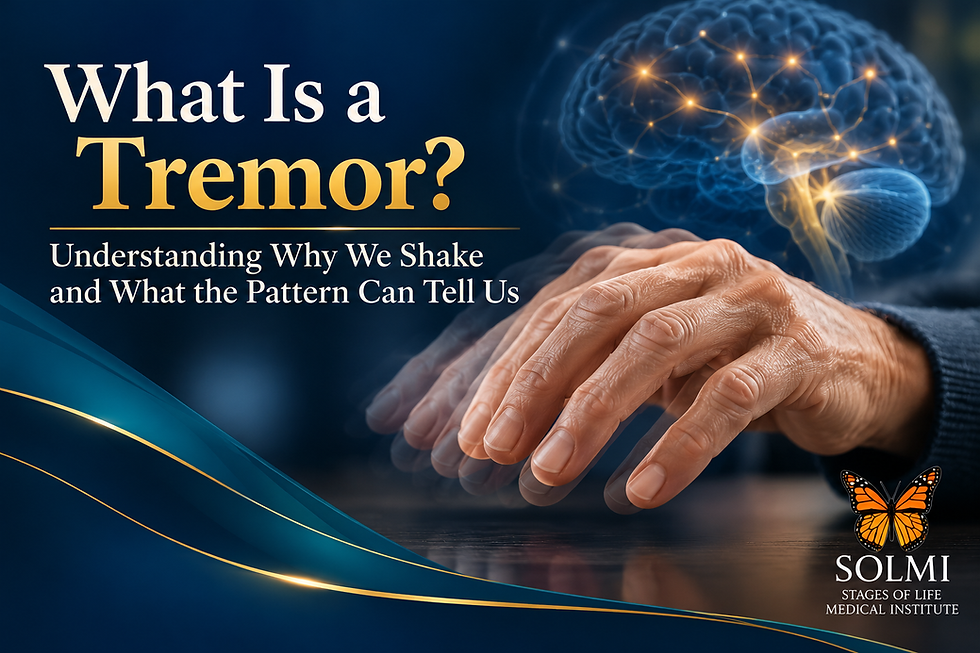
What Is a Tremor? Understanding Why We Shake and What the Pattern Can Tell Us
Not every involuntary muscle movement is the same. This article explains the differences among resting, action, postural, and medication-related tremors. Understanding these patterns helps patients appreciate why the characteristics of an abnormal movement are important in determining its cause.
When One Diagnosis Follows You Everywhere: The Value of an Independent Second Opinion
When facial twitching persists, spreads, or fails to respond to treatment, reconsidering the original diagnosis may be appropriate. This article explains diagnostic anchoring and how an independent evaluation can help clarify unexplained symptoms.
L-Glycine: An Overlooked Amino Acid for Sleep, Anxiety, Recovery, and Longevity
Sleep deprivation and stress can aggravate benign eyelid twitching. This article explores glycine's role in inhibitory neurotransmission, sleep regulation, and recovery. It provides useful background without suggesting that glycine supplementation is an established treatment for eyelid spasms.
Your Ferritin May Be Low or “In Range”—But Is It Too Low for Healthy Hair?
Nutritional assessment requires more than simply checking whether a laboratory result falls within a reference interval. This article illustrates the importance of interpreting laboratory findings in clinical context and investigating underlying causes before recommending supplementation.
Become a Patient
At Stages of Life Medical Institute, we believe that careful clinical evaluation and individualized treatment are essential to understanding persistent or unexplained symptoms.
1917 Boothe Circle
Longwood, Florida 32750
Telephone: 407-679-3337
Medical Disclaimer
This article is provided for educational purposes and does not replace individualized medical advice, diagnosis, or treatment. New, persistent, progressive, or unusual neurological symptoms should be evaluated by a qualified healthcare professional.
© 2026 Stages of Life Medical Institute. All rights reserved.
The medical references cited in this article are provided for educational purposes only and are intended to support general scientific discussion. They are not a substitute for individualized medical advice, diagnosis, or treatment. Clinical decisions should always be made in consultation with a qualified healthcare professional who can account for a patient’s unique medical history, medications, and circumstances.


1917 Boothe Circle, Suite 171
Longwood, Florida 32750
Tel: 407-679-3337
Fax: 407-678-7246