PCOS, Polycystic ovary syndrome: Why Insulin and Testosterone Matter:

David S. Klein, MD, FACA, FACPM, FAAMIMS
Stages of Life Medical Institute

Quick Look
Polycystic ovary syndrome (PCOS) is more than an ovarian disorder. It is a complex endocrine and metabolic condition frequently associated with:
insulin resistance,
elevated insulin,
and excessive androgen activity.
Understanding the relationship between insulin and testosterone helps explain irregular periods, infertility, acne, unwanted facial hair, and long-term metabolic risks. Accurate diagnosis requires distinguishing PCOS from other hormonal disorders.
Polycystic ovary syndrome, commonly called PCOS, is one of the most common endocrine disorders affecting women of reproductive age.
Despite its name, PCOS is not simply a disease of ovarian cysts. It is a syndrome involving abnormalities in ovarian function, androgen activity, and frequently insulin metabolism.
Women often seek medical attention because of irregular menstrual periods, difficulty becoming pregnant, weight gain, persistent acne, or unwanted facial hair.
However, these outward symptoms may reflect a much broader metabolic disturbance.
**One of the most important physiological relationships in PCOS is the interaction between insulin and testosterone.**¹²
Understanding this relationship helps explain why PCOS should be evaluated as both a reproductive and a metabolic disorder.
The Insulin–Testosterone Connection
Insulin is best known as the hormone that helps glucose enter cells. However, insulin also influences ovarian hormone production. When tissues become resistant to insulin, the pancreas often compensates by producing larger amounts of insulin.
This is called compensatory hyperinsulinemia.
Excess insulin can stimulate ovarian theca cells to increase androgen production, particularly testosterone.
At the same time, elevated insulin suppresses the liver's production of sex hormone-binding globulin (SHBG).
SHBG normally binds circulating testosterone, limiting the amount available to act on tissues.
When SHBG decreases, free testosterone may increase, even when total testosterone is only mildly elevated.
The result is a reinforcing interaction among insulin resistance, androgen excess, and impaired ovarian function.²³
See Figure 1: The Insulin–Testosterone Connection in PCOS.

Why Elevated Insulin Deserves Special Attention
A woman may have normal fasting glucose and hemoglobin A1c while already demonstrating significant insulin resistance.
This occurs because the pancreas may compensate for reduced insulin sensitivity by secreting additional insulin. As a result, glucose concentrations may remain within conventional reference ranges for years.
Consider two women with identical fasting glucose concentrations:
Measurement | Patient A | Patient B |
Fasting glucose | 88 mg/dL | 88 mg/dL |
Fasting insulin | 5 µIU/mL | 20 µIU/mL |
Glucose interpretation | Normal | Normal |
Metabolic interpretation | Lower insulin requirement | Possible compensatory hyperinsulinemia |
Although both patients have identical glucose concentrations, Patient B has a substantially higher circulating insulin concentration.
This may be an important metabolic clue.
However, fasting insulin varies with assay methodology, adiposity, insulin clearance, and other physiological factors. There is no universally accepted fasting-insulin cutoff for diagnosing PCOS or insulin resistance.
Clinical Pearl
Normal glucose does not necessarily mean normal insulin metabolism.
In selected patients, measuring fasting insulin alongside glucose may provide additional physiological information, even though fasting insulin is not recommended as a routine diagnostic test for PCOS.
The question is not simply whether glucose is normal, but whether metabolic dysfunction is developing before glucose becomes abnormal.
Why Testosterone Is Equally Important
Testosterone is normally present in women, although at much lower concentrations than in men.
In PCOS, excessive androgen production may contribute to:
Unwanted facial and body hair
Persistent acne
Thinning scalp hair
Menstrual irregularities
Impaired ovulation
Difficulty becoming pregnant
Laboratory evaluation should distinguish total testosterone from free testosterone.
Because elevated insulin can reduce SHBG, a woman may have increased free testosterone despite a relatively unremarkable total testosterone concentration.
For this reason, accurate total testosterone measurement, preferably by liquid chromatography–tandem mass spectrometry (LC-MS/MS), together with SHBG and calculated free testosterone, can be particularly informative.¹
See Figure 2: How Insulin, SHBG, and Testosterone Interact.
Must Both Insulin and Testosterone Be Elevated to Diagnose PCOS?
This question deserves special attention. The coexistence of hyperinsulinemia and elevated testosterone strongly supports a metabolically affected, hyperandrogenic PCOS phenotype when compatible clinical findings are present. However, current international guidelines do not require both laboratory abnormalities to establish PCOS.
In adults, diagnosis generally requires at least two of the following three findings, after excluding alternative causes:
Hyperandrogenism: Clinical findings such as hirsutism or biochemical evidence of androgen excess.
Ovulatory dysfunction: Irregular menstrual cycles or other evidence of impaired ovulation.
Polycystic ovarian morphology: Characteristic ultrasound findings or an appropriately interpreted elevated anti-Müllerian hormone (AMH) concentration.
When irregular menstrual cycles and hyperandrogenism are already established, ovarian ultrasound may not be necessary.
Adolescents require both hyperandrogenism and ovulatory dysfunction; ultrasound and AMH are not recommended for adolescent diagnosis.¹
Thus, elevated insulin and testosterone are important physiological findings, but neither is individually mandatory.
This distinction prevents women with less obvious biochemical abnormalities from being incorrectly excluded from diagnosis.
Why Is PCOS Over-diagnosed?
Polycystic ovary syndrome is a common and important endocrine disorder. However, an equally important question deserves attention:
Are some women being diagnosed with PCOS when they actually have another hormonal or metabolic disorder?
The answer is yes.
Although PCOS is unquestionably prevalent, several features of its diagnostic criteria can contribute to overdiagnosis, particularly when clinicians rely on isolated findings rather than a comprehensive endocrine evaluation.
1. Polycystic-Appearing Ovaries Do Not Necessarily Mean PCOS
One of the most common sources of diagnostic confusion is ovarian ultrasound. Many otherwise healthy women have ovaries containing numerous small follicles. This appearance may be described as polycystic ovarian morphology, but it does not necessarily indicate a pathological condition.
Indeed, polycystic ovarian morphology may occur in women with normal menstrual cycles, normal androgen concentrations, and normal fertility.
An ultrasound finding alone does not establish PCOS.
Improvements in ultrasound technology have increased the number of follicles that can be detected, making the use of outdated follicle-count thresholds particularly problematic.
2. Irregular Menstrual Periods Have Many Causes
Menstrual irregularity is frequently attributed to PCOS, especially in younger women.
However, irregular menstrual cycles may result from:
Hypothyroidism or other thyroid dysfunction
Hyperprolactinemia
Functional hypothalamic amenorrhea associated with stress, inadequate caloric intake, or excessive exercise
Perimenopause or primary ovarian insufficiency
Medication effects
Normal physiological maturation during adolescence
Without an appropriate differential diagnosis, these conditions may be incorrectly labeled PCOS.
3. Mildly Elevated Testosterone Is Not Always PCOS
An elevated testosterone concentration may support a diagnosis of PCOS, but it is not specific to the syndrome.
Androgen excess can also occur with non-classic congenital adrenal hyperplasia, ovarian or adrenal tumors, exogenous androgen exposure, and other endocrine disorders.
Testosterone testing in women also presents analytical challenges. Many conventional immunoassays perform poorly at the relatively low testosterone concentrations typical of women.
For this reason, accurate total testosterone measurement using LC-MS/MS is preferred when available.
Free testosterone should be assessed using a validated method or calculated from appropriate measurements rather than relying on inaccurate direct free-testosterone immunoassays.
A single borderline laboratory result should not automatically establish a lifelong endocrine diagnosis.
4. Obesity and Insulin Resistance Can Complicate the Picture
Obesity, insulin resistance, and hyperinsulinemia frequently coexist with PCOS. However, these metabolic abnormalities are not unique to PCOS.
Women without PCOS may have significant insulin resistance, elevated fasting insulin, reduced SHBG, and alterations in circulating androgen availability.
Consequently, the presence of obesity or insulin resistance should not automatically lead to a diagnosis of PCOS. Conversely, the absence of obesity or demonstrable hyperinsulinemia does not exclude PCOS.
Metabolic abnormalities should be interpreted as important physiological evidence rather than independent diagnostic proof.
5. Adolescents Are Particularly Vulnerable to Overdiagnosis
During normal puberty, menstrual cycles may be irregular for several years. Acne is common, androgen concentrations change during maturation, and multifollicular ovaries may be a normal developmental finding. These characteristics overlap with features of PCOS.
Consequently, international guidelines require both persistent ovulatory dysfunction, interpreted according to years since menarche, and clinical or biochemical hyperandrogenism before diagnosing PCOS in adolescents.
Ovarian ultrasound and AMH testing are not recommended for establishing the diagnosis during adolescence.
Some adolescents who do not meet full criteria may instead be classified as being at increased risk for PCOS, with appropriate longitudinal reassessment.¹⁷
6. Different Diagnostic Criteria Can Produce Different Prevalence Estimates
Not all diagnostic frameworks identify precisely the same patients. The Rotterdam criteria permit diagnosis in adults when two of three characteristic features are present, after exclusion of alternative causes.
This allows identification of women who have ovulatory dysfunction and polycystic ovarian morphology without demonstrable hyperandrogenism.
Other diagnostic frameworks place greater emphasis on androgen excess. As a result, prevalence estimates vary according to the criteria used.⁶
This does not necessarily mean that every additional diagnosis is incorrect. Rather, it demonstrates that PCOS encompasses biologically heterogeneous phenotypes and that diagnostic thresholds influence who receives the label.
The non-hyperandrogenic phenotype remains an area of clinical and scientific interest.
Clinical Pearl
Polycystic ovarian morphology, irregular menstruation, or insulin resistance should never be interpreted in isolation as proof of PCOS.
When hyperinsulinemia and biochemical hyperandrogenism coexist, they provide compelling evidence of a metabolically affected, hyperandrogenic phenotype—but alternative causes must still be excluded. A careful diagnosis should explain the patient's reproductive findings, androgen status, and metabolic physiology rather than simply assigning a syndrome label.
Why Does Overdiagnosis Matter?
An incorrect PCOS diagnosis can have meaningful consequences.
A woman may experience unnecessary anxiety about fertility, assume that she has a lifelong endocrine disorder, or receive treatment that does not address the actual cause of her symptoms.
More importantly, another treatable condition—such as thyroid dysfunction, hyperprolactinemia, or hypothalamic amenorrhea—may be overlooked. At the same time, excessive diagnostic skepticism can produce the opposite problem: underdiagnosis in women who genuinely have PCOS but lack obvious obesity, elevated fasting insulin, or markedly increased testosterone.
The objective should be diagnostic precision, not simply diagnosing more or fewer women with PCOS.
The most defensible approach combines established diagnostic criteria with careful exclusion of alternative disorders and a thorough evaluation of metabolic health.
What Symptoms Should Raise Suspicion?
PCOS can produce symptoms that initially appear unrelated. Common manifestations include:
irregular or absent menstrual periods,
infertility,
excessive facial or body hair,
acne,
scalp hair thinning,
weight gain,
and increased abdominal fat accumulation.
Some women develop acanthosis nigricans, a darkened, velvety thickening of skin often associated with insulin resistance.
Others have relatively few visible manifestations. Importantly, PCOS can occur in women who are not overweight.
What Laboratory Tests Should Be Considered?
A thoughtful evaluation considers both reproductive endocrinology and metabolic health.
Laboratory test | Clinical purpose |
Total testosterone (LC-MS/MS preferred) | Detects biochemical androgen excess |
SHBG and calculated free testosterone | Evaluates free androgen activity |
Fasting glucose | Assesses fasting glycemia |
Hemoglobin A1c | Assesses longer-term glycemic status |
75-g oral glucose tolerance test | Preferred assessment of glycemic status in PCOS |
Fasting insulin | Optional physiological context; not a validated diagnostic criterion |
Lipid profile | Evaluates cardiometabolic risk |
TSH and prolactin | Helps exclude alternative diagnoses |
17-hydroxyprogesterone | Screens for nonclassic congenital adrenal hyperplasia |
DHEAS, androstenedione, and additional endocrine investigations may be indicated in selected patients.
Rapidly progressive androgenic symptoms, virilization, or markedly elevated testosterone should prompt investigation for other causes, including androgen-secreting tumors.
What About HOMA-IR?
HOMA-IR is a commonly used research estimate of insulin resistance calculated from fasting glucose and fasting insulin.⁵
Using conventional U.S. units:
HOMA-IR = Fasting insulin (µIU/mL) × Fasting glucose (mg/dL) ÷ 405
Although useful in research and sometimes for metabolic characterization, HOMA-IR lacks a universally accepted diagnostic threshold and is not recommended as a routine diagnostic requirement for PCOS.
Why PCOS Matters Beyond Fertility
PCOS is associated with several important long-term health concerns.
These include:
impaired glucose tolerance,
type 2 diabetes,
dyslipidemia,
obstructive sleep apnea,
and increased cardiovascular risk factors.
Chronic anovulation may also increase the risk of endometrial hyperplasia and endometrial cancer, particularly when prolonged periods occur without adequate progesterone exposure.
Depression, anxiety, and reduced quality of life are also more common among women with PCOS.¹
See Figure 3: PCOS as a Reproductive and Metabolic Syndrome.
These associations demonstrate why PCOS should not be treated exclusively as a fertility disorder.
Treatment: Addressing Both Hormones and Metabolism
Treatment should be individualized according to the patient's symptoms, reproductive goals, metabolic findings, and preferences.
Lifestyle and Metabolic Health
Regular physical activity, resistance training, adequate sleep, and nutritionally balanced eating patterns are foundational.
For patients with excess adiposity, modest weight reduction can improve metabolic and reproductive outcomes. However, healthy lifestyle measures are beneficial even without weight loss.
Metformin
Metformin may improve metabolic outcomes in selected women with PCOS, particularly those with elevated metabolic risk.
Its effects on insulin sensitivity may also indirectly influence ovarian androgen physiology.
Hormonal Treatment
Combined oral contraceptives are frequently used to regulate menstrual cycles and improve androgen-related symptoms when pregnancy is not desired.
Other treatments for hirsutism and acne may be considered depending on individual circumstances.
Fertility Treatment
For women seeking pregnancy who have anovulatory PCOS without other infertility factors, letrozole is generally the preferred first-line medication for ovulation induction.¹
The goal of treatment is not simply to normalize testosterone or insulin.
It is to restore healthier reproductive function, address symptoms, and reduce long-term metabolic risk.
Frequently Asked Questions
Can PCOS occur with normal blood glucose?
Yes. Insulin resistance and compensatory hyperinsulinemia may be present before fasting glucose or A1c becomes abnormal.
Must both insulin and testosterone be elevated?
No. Their coexistence provides useful evidence of a particular PCOS phenotype, but both elevations are not required by established diagnostic criteria.
Can PCOS occur without ovarian cysts?
Yes. Polycystic ovarian morphology is not mandatory when the other adult diagnostic criteria are met.
Does every woman with PCOS have insulin resistance?
No. Insulin resistance is common but varies substantially among affected women.
Can a thin woman have PCOS?
Yes. Lean PCOS is well recognized.
Why is PCOS sometimes overdiagnosed?
Because irregular menstruation, acne, elevated androgens, and polycystic-appearing ovaries can occur in other conditions or normal physiological states. A careful evaluation is necessary before establishing the diagnosis.
Can PCOS be cured?
There is currently no established permanent cure. However, symptoms, ovulatory dysfunction, and metabolic risk can often be substantially improved with appropriate treatment.
Bottom Line
Polycystic ovary syndrome is a complex endocrine and metabolic condition rather than simply an ovarian disorder.
The relationship between insulin resistance, elevated insulin, reduced SHBG, and excessive androgen activity is central to understanding many cases of PCOS.
When elevated insulin and testosterone coexist, they provide valuable evidence of the underlying metabolic and hormonal disturbance. However, diagnosis must remain grounded in established clinical criteria rather than requiring both laboratory abnormalities in every patient.
Equally important, PCOS should not be diagnosed solely because a woman has irregular menstrual periods, ovarian follicles, obesity, or a borderline testosterone result. A comprehensive approach addresses reproductive health, metabolic risk, diagnostic accuracy, and the broader physiological processes that influence long-term health.
Continue Your Journey to Better Health
At Stages of Life Medical Institute, we believe that understanding the connections among insulin metabolism, hormones, and chronic disease is essential to identifying underlying causes rather than simply treating symptoms.
PCOS provides an excellent example of how abnormalities in one hormonal system can influence several others. The following published articles explore these relationships in greater detail.
Learn why normal fasting glucose may conceal compensatory hyperinsulinemia and how insulin measurements can provide additional metabolic information. Particularly relevant for women with PCOS whose glucose levels remain normal despite suspected insulin resistance.
Explore the early metabolic changes that can precede type 2 diabetes and why identifying impaired glucose regulation is especially important in women with PCOS.
Understand how persistently elevated insulin may affect multiple organ systems and why insulin metabolism deserves attention beyond conventional glucose testing.
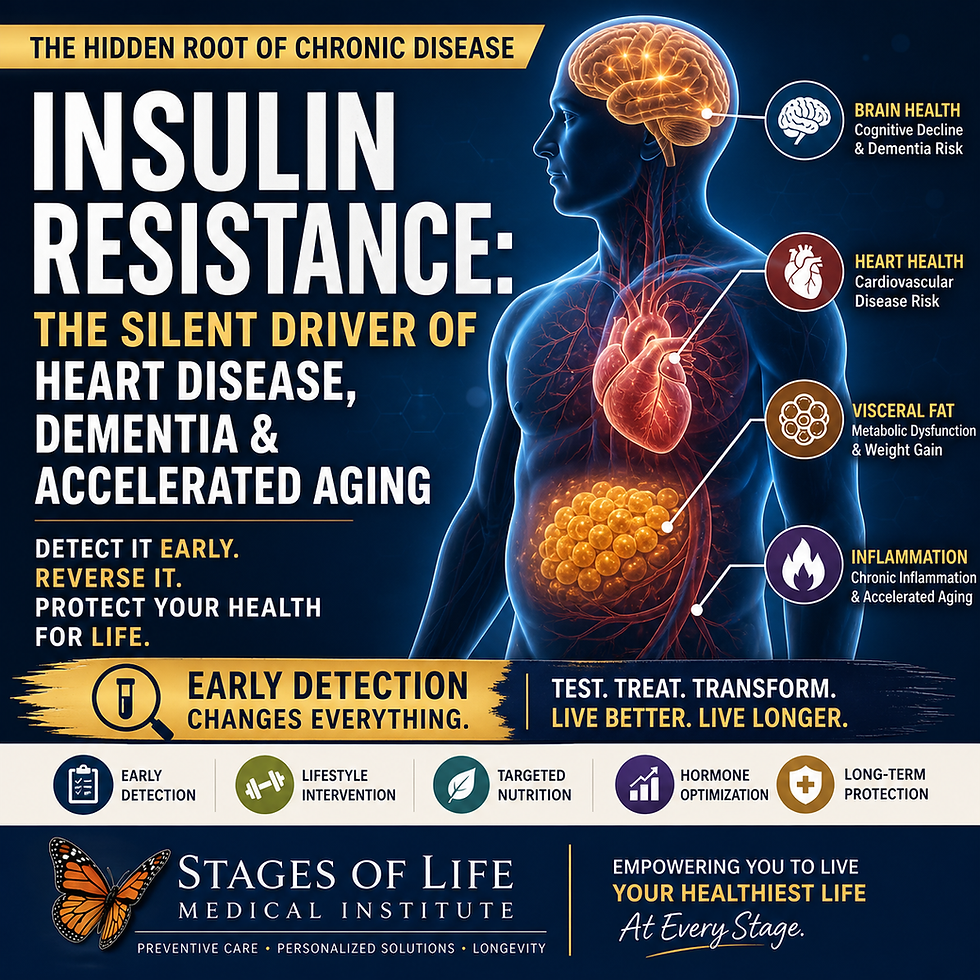
4. Insulin Resistance: The Hidden Precursor to Cardiovascular Disease, Dementia, and Accelerated Aging
Examine the broader implications of insulin resistance, including its associations with cardiovascular and neurological health. This provides important context for the long-term metabolic risks associated with PCOS.
Review practical nutritional and lifestyle approaches that may improve insulin sensitivity and reduce excessive insulin demand.
6. Insulin Resistance: The Hidden Precursor to Cardiovascular Disease, Dementia, and Accelerated Aging
This separately published discussion explores the progression from early insulin resistance to systemic metabolic complications, emphasizing the importance of recognizing dysfunction before overt disease develops.
Together, these articles support a systems-based understanding of PCOS and illustrate why reproductive hormones and metabolic health should be evaluated together.
Become a Patient
At Stages of Life Medical Institute, we believe that understanding the underlying causes of illness is an essential part of effective medical care.
Our approach emphasizes individualized assessment, careful laboratory interpretation, and the relationships among metabolic, endocrine, and reproductive health.
Stages of Life Medical Institute
1917 Boothe Circle
Longwood, Florida 32750
Telephone: 407-679-3337
Medical Disclaimer
This article is intended for educational purposes and does not replace individualized medical evaluation, diagnosis, or treatment. Laboratory findings should always be interpreted in the context of symptoms, medical history, and established diagnostic criteria.
Scientific References
Teede HJ, et al. Recommendations from the 2023 International Evidence-based Guideline for the Assessment and Management of Polycystic Ovary Syndrome. J Clin Endocrinol Metab. 2023;108(10):2447–2469. PubMed.
Rosenfield RL, Ehrmann DA. The Pathogenesis of Polycystic Ovary Syndrome (PCOS): The Hypothesis of PCOS as Functional Ovarian Hyperandrogenism Revisited. Endocr Rev. 2016;37(5):467–520. PubMed.
Dunaif A. Insulin Resistance and the Polycystic Ovary Syndrome: Mechanism and Implications for Pathogenesis. Endocr Rev. 1997;18(6):774–800. PubMed.
Legro RS, et al. Diagnosis and Treatment of Polycystic Ovary Syndrome: An Endocrine Society Clinical Practice Guideline. J Clin Endocrinol Metab. 2013;98(12):4565–4592. PubMed.
Matthews DR, et al. Homeostasis Model Assessment: Insulin Resistance and Beta-Cell Function from Fasting Plasma Glucose and Insulin Concentrations in Man. Diabetologia. 1985;28:412–419. PubMed.
Lizneva D, et al. Criteria, Prevalence, and Phenotypes of Polycystic Ovary Syndrome. Fertil Steril. 2016;106(1):6–15. PubMed.
Peña AS, et al. Adolescent Polycystic Ovary Syndrome According to the International Evidence-Based Guideline. BMC Med. 2020;18:72. PubMed.
Azziz R, et al. Polycystic Ovary Syndrome. Nat Rev Dis Primers. 2016;2:16057. PubMed.
The medical references cited in this article are provided for educational purposes only and are intended to support general scientific discussion. They are not a substitute for individualized medical advice, diagnosis, or treatment. Clinical decisions should always be made in consultation with a qualified healthcare professional who can account for a patient’s unique medical history, medications, and circumstances.


1917 Boothe Circle, Suite 171
Longwood, Florida 32750
Tel: 407-679-3337
Fax: 407-678-7246

© 2026 Stages of Life Medical Institute. All rights reserved.