


Lactoferrin Containing Colostrum: Targeted Support for Sleep, Immunity, and Respiratory Health

Bovine colostrum—the “first milk” produced in the first days after calving—is naturally enriched with immune-active proteins, growth factors, and protective peptides. Among these, lactoferrin stands out as a multifunctional iron-binding glycoprotein with antibacterial, antiviral, anti-inflammatory, and immunomodulatory effects.MDPI+1 When colostrum supplements retain biologically active lactoferrin, they offer a focused way to support the immune system, enhance resistance to upper respiratory infections, and even influence sleep quality through the gut–brain–immune axis.
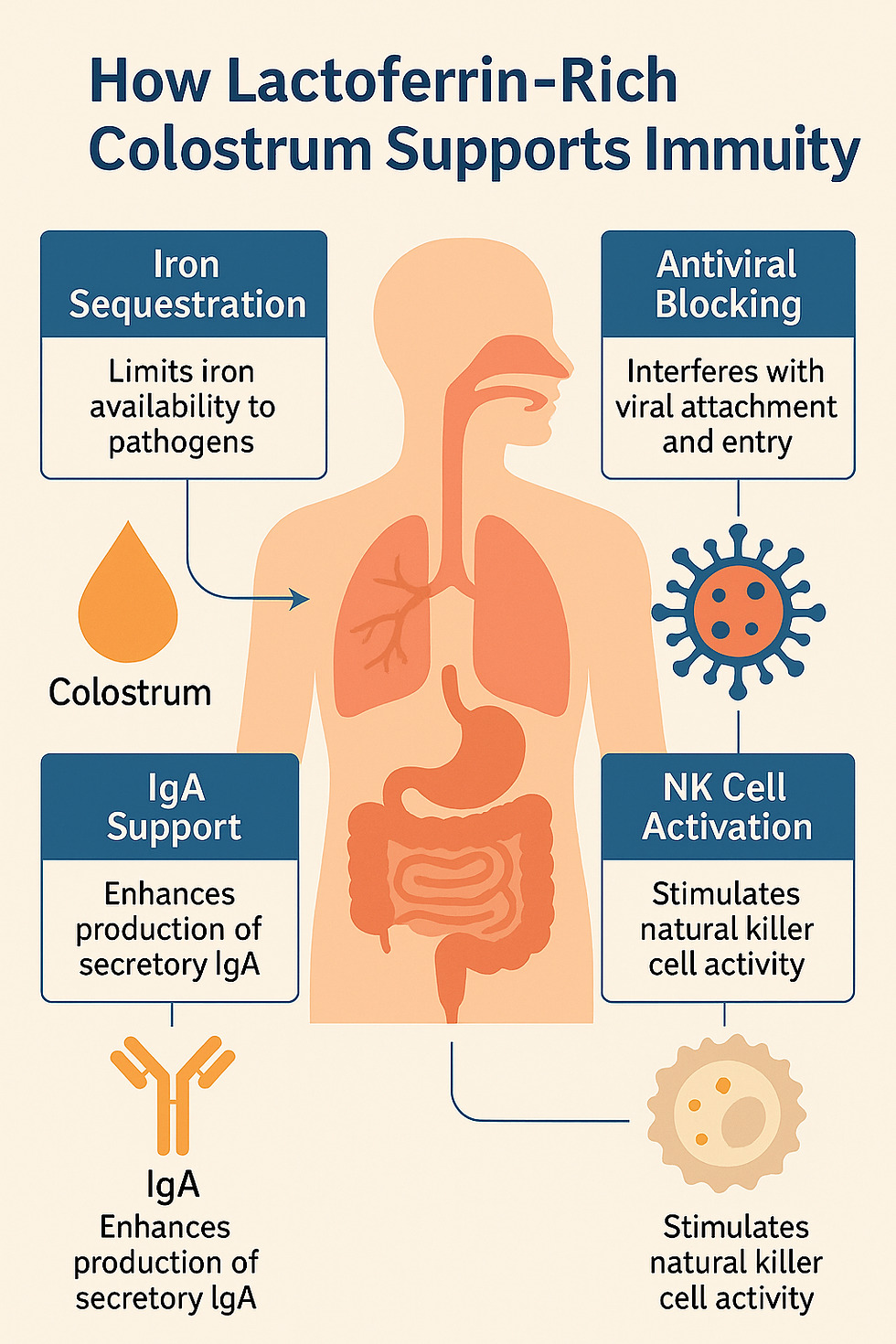
It is important to recognize that not all colostrum products are equivalent. Some are overly processed, diluted, or derived from later milkings, which markedly reduces their lactoferrin content. Clinically, the benefits described below are most relevant to preparations with quantified, biologically active lactoferrin, rather than generic “colostrum” powders without standardization.
How Lactoferrin-Containing Colostrum Works
Lactoferrin exerts its effects through several complementary mechanisms. As an iron-binding protein, it limits free iron availability to bacteria, inhibiting their growth and biofilm formation. It also interacts directly with viral particles and host cell receptors, blocking viral attachment and entry for a range of respiratory viruses.PMC+1 At the mucosal surface, lactoferrin enhances secretory IgA, supports tight junction integrity, and modulates innate cells such as neutrophils, dendritic cells, and natural killer (NK) cells.Nature+1
Colostrum itself supplies a matrix of immunoglobulins, proline-rich polypeptides, growth factors, and oligosaccharides that act as prebiotics and trophic factors for the gut epithelium. Contemporary reviews highlight bovine colostrum as a promising adjunct for respiratory and gastrointestinal infections and as a supportive strategy during viral epidemics, including COVID-19.Frontiers+1 When combined, colostrum and its lactoferrin fraction support both barrier defense and systemic immune regulation.
Clinical Evidence for Immune and Upper Respiratory Protection
Multiple randomized and controlled clinical trials support the role of lactoferrin and colostrum in reducing the frequency and severity of upper respiratory tract infections (URTIs). A meta-analysis of randomized trials involving nearly 1,200 participants found that lactoferrin supplementation reduced the odds of respiratory tract infections by about 40–45% compared with control.PubMed In healthy adults, a 12-week randomized, double-blind trial of bovine lactoferrin (200 mg/day) demonstrated fewer respiratory and systemic symptoms, alongside enhanced plasmacytoid dendritic cell (pDC) function—key sentinels for antiviral defense.MDPI
Colostrum itself has been studied in several populations. In children with recurrent URTIs and diarrhea, a 4-week course of bovine colostrum significantly reduced total infections, URTI episodes, and hospitalizations over the following six months.PubMed A randomized trial in medical university students showed that moderate-dose colostrum supplementation lowered the incidence of URTIs compared with placebo, with benefits persisting for weeks after cessation.MDPI Earlier athletic studies have also reported fewer URTI symptoms and shortened illness duration in heavily trained adults receiving colostrum, consistent with colostrum’s capacity to counteract exercise-induced immune suppression.PMC+1
Mechanistically, lactoferrin and colostrum appear to reduce respiratory susceptibility by:
Enhancing type I interferon responses and NK cell activity
Supporting mucosal IgA production and epithelial integrity
Limiting pathogen adhesion and biofilm formation along the nasopharyngeal and intestinal mucosae
These effects align with the clinical observation that URTIs become less frequent and less severe in individuals taking standardized lactoferrin-containing colostrum over several weeks.
Lactoferrin, Sleep Quality, and the Gut–Brain–Immune Axis

Although most people think of lactoferrin as purely an “immune protein,” emerging research suggests it can influence sleep and circadian regulation via neuroinflammatory and gut-brain pathways. A randomized, double-blind, placebo-controlled trial in young children using a lactoferrin-fortified formula (48 mg/day) over 13 weeks showed improved morning behavior and reduced “hard to wake up” scores compared with placebo, suggesting better sleep quality even though total sleep time did not change.PubMed

In adults, pilot work with liposomal lactoferrin has demonstrated improved subjective and actigraphy-measured sleep quality and reduced jetlag after long-haul travel, potentially through suppression of hippocampal neuroinflammation and modulation of inflammatory cytokines that perturb sleep architecture.MDPI Earlier randomized studies in “poor sleepers” likewise indicate better perceived depth of sleep and morning refreshment with lactoferrin, in parallel with improvements in the enteric environment—highlighting the relevance of the gut–brain axis.MDPI+1
When colostrum serves as the delivery vehicle for lactoferrin, patients may gain both nocturnal immune support (particularly relevant during viral seasons) and subtle normalization of sleep quality. Clinically, this pairing is attractive for individuals whose sleep is degraded by recurrent infections, travel, chronic inflammation, or low-grade dysbiosis.
Practical Considerations and Product Quality
From a safety perspective, bovine lactoferrin has been granted “generally recognized as safe” (GRAS) status by regulatory authorities and approved as a novel food ingredient in the European Union.MDPI+1 Trials across infants, children, adults, and older adults consistently report good tolerability, with adverse events comparable to placebo.
However, not all colostrum products meaningfully deliver lactoferrin. Factors that can reduce bioactive lactoferrin include late collection (beyond the true colostrum window), aggressive heat treatment, defatting and fractionation processes, or dilution with standard whey or milk powders. As a result, a label that simply reads “bovine colostrum” does not guarantee significant lactoferrin content. Patients seeking the immune and sleep-related benefits described above should look for products that:
Declare standardized lactoferrin content (e.g., mg of lactoferrin per serving)
Use low-temperature processing and early-milking colostrum
Provide third-party testing for active proteins where available
Dosages used in clinical trials vary, but commonly range from 40–200 mg/day of purified lactoferrin for children and adults, with colostrum doses typically in the grams-per-day range.PubMed+2MDPI+2 Individual needs, comorbidities, and concomitant therapies should be considered in consultation with a qualified clinician.

Conclusion
Lactoferrin-rich colostrum occupies a unique niche at the intersection of mucosal immunity, systemic inflammatory control, and sleep regulation. By combining the broad matrix of colostrum with the targeted antiviral, antibacterial, and immunomodulatory activity of lactoferrin, these preparations can reduce the burden of upper respiratory infections, support resilient immune function, and modestly improve sleep quality in selected populations. As with any therapeutic nutrient, careful attention to product selection, dose, and clinical context is essential—but the evidence base for lactoferrin-containing colostrum as a safe, physiology-aligned adjunct continues to grow.
References
Miyakawa M, Kubo S, Oda H, et al. Effects of lactoferrin on sleep conditions in children aged 12–32 months: a preliminary, randomized, double-blind, placebo-controlled trial. Nat Sci Sleep. 2020;12:671-677. doi:10.2147/NSS.S263106.PubMed
Uesaki S, et al. Liposomal lactoferrin reduces brain neuroinflammation in rats and alleviates jetlag and improves sleep quality after long-haul travel. NeuroSci. 2025;6(1):19. doi:10.3390/neurosci6010019.MDPI
Oda H, et al. Effects of bovine lactoferrin on the maintenance of respiratory and systemic physical conditions in healthy adults: a randomized, double-blind, placebo-controlled trial. Nutrients. 2023;15(18):3959. doi:10.3390/nu15183959.MDPI
Ali AS, Hasan SS, Kow CS, Merchant HA. Lactoferrin reduces the risk of respiratory tract infections: a meta-analysis of randomized controlled trials. Clin Nutr ESPEN. 2021;45:26-32. doi:10.1016/j.clnesp.2021.08.019.PubMed+1
Manzoni P, et al. Lactoferrin supplementation in preventing and protecting from SARS-CoV-2 infection: an updated review of literature. Int J Mol Sci. 2024;25(19):10248. doi:10.3390/ijms251910248.MDPI
Hong R, Xie X, Zhou Q, et al. A comprehensive review of research advances in the study of lactoferrin bioactivity and mechanisms. Food Funct. 2024;15(3):xxxx-xxxx. doi:10.1039/d4fo02083a.RSC Publishing
Eker F, et al. The potential of lactoferrin as antiviral and immune-modulating agent: current evidence and future perspectives. J Med Virol. 2024;xx(x):xxxx-xxxx.PMC
Kim JW, et al. The multifaceted functions of lactoferrin in antimicrobial defense and immune modulation. Biomolecules. 2025;15(8):1174. doi:10.3390/biom15081174.MDPI
Siqueiros-Cendón T, Arévalo-Gallegos S, Iglesias-Figueroa BF, et al. Immunomodulatory effects of lactoferrin. Acta Pharmacol Sin. 2014;35(5):557-566. doi:10.1038/aps.2013.200.Nature
Actor JK, Hwang SA, Kruzel ML. Lactoferrin as a natural immune modulator. J Cell Mol Med. 2009;13(9B):2971-2984.PMC
Kell DB, Heyden EL, Pretorius E. The biology of lactoferrin, an iron-binding protein that can help defend against viral infection and inflammation. Front Immunol. 2020;11:1221. doi:10.3389/fimmu.2020.01221.Frontiers
Saad K, Abo-Elella SSA, El-Baseer KAA, et al. Effects of bovine colostrum on recurrent respiratory tract infections and diarrhea in children. Medicine (Baltimore). 2016;95(37):e4560. doi:10.1097/MD.0000000000004560.PubMed
Baśkiewicz-Hałasa M, Stachowska E, Grochans E, et al. Moderate dose bovine colostrum supplementation in prevention of upper respiratory tract infections in medical university students: a randomized, triple blind, placebo-controlled trial. Nutrients. 2023;15(8):1925. doi:10.3390/nu15081925.MDPI
Brinkworth GD, Buckley JD. Concentrated bovine colostrum protein supplementation reduces the incidence of self-reported symptoms of upper respiratory tract infection in adult males. Eur J Nutr. 2003;42(4):228-232.Worldwide Journals
Jones AW, Cameron SJ, Thatcher R, et al. Effects of bovine colostrum supplementation on upper respiratory illness in active males. Brain Behav Immun. 2014;39:194-203.Worldwide Journals
Galdino ABS, Rangel AHDN, Buttar HS, et al. Bovine colostrum: benefits for the human respiratory system and potential contributions for clinical management of COVID-19. Food Agric Immunol. 2021;32(1):143-162. doi:10.1080/09540105.2021.1892594.ResearchGate
Duman H, et al. Bovine colostrum and its potential contributions for prevention and treatment of COVID-19 and other respiratory infections. Front Immunol. 2023;14:1214514.Frontiers
Burton C, et al. Impact of lactoferrin supplementation on respiratory tract infections in an elderly population: randomized, double-blind, placebo-controlled study. Clin Nutr ESPEN. 2023;xx(x):xxxx-xxxx.ScienceDirect
Oda H, et al. Maintenance of respiratory and systemic conditions by bovine lactoferrin and plasmacytoid dendritic cell activation: randomized controlled data. Nutrients. 2020;12(9):xxxx-xxxx.MDPI
Miyakawa M, Abe F, Nomiyama T. Clinical research review: usefulness of bovine lactoferrin in pediatric and adult health, with a focus on sleep and neurodevelopment. Biometals. 2023;36(3):543-560.SpringerLink


1917 Boothe Circle, Suite 171
Longwood, Florida 32750
Tel: 407-679-3337
Fax: 407-678-7246


.webp)