


DHT and Hair Loss: When Hormones Attack the Hair Follicle

Stages of Life Medical Institute | Patient Education Blog
By David S. Klein, MD, FACA, FACPM, FAAMIMS

Quick Look
Dihydrotestosterone (DHT) is a potent androgen formed from testosterone. In genetically susceptible individuals, DHT progressively shrinks scalp hair follicles, producing thinner, shorter hairs and eventually visible hair loss. However, elevated DHT is not required for this process. Normal hormone levels can coexist with substantial hair loss, and not all thinning hair is caused by DHT.
1. What Is DHT, and Why Does It Matter?
Dihydrotestosterone, commonly abbreviated DHT, is an androgen produced when the enzyme 5-alpha-reductase converts testosterone into DHT.
Although testosterone is often considered the principal male sex hormone, DHT is particularly potent in tissues such as the prostate, skin, and hair follicles. DHT binds strongly to androgen receptors and produces biological effects that differ according to the tissue involved.
For example, DHT contributes to facial and body hair development during puberty. Yet in genetically susceptible scalp follicles, the same hormone can cause progressive hair thinning.
This apparent contradiction is fundamental to understanding androgenetic alopecia, commonly called male or female pattern hair loss.¹
2. How Does DHT Cause Hair Loss?
Hair follicles do not simply grow hair continuously. They pass through a repeating biological cycle:
Anagen: Active hair growth, normally lasting several years on the scalp.
Catagen: A brief transitional phase.
Telogen: A resting phase before shedding.
Exogen: Release of the old hair shaft.
In androgenetic alopecia, DHT acts on genetically susceptible follicles, particularly within the frontal scalp, temples, and crown. Over successive hair cycles, these follicles become progressively smaller, a process called follicular miniaturization.

Figure 1: DHT-associated follicular miniaturization, progressing from thick terminal hair to increasingly fine, shortened hair shafts.
As miniaturization progresses:
The anagen growth phase becomes shorter.
Hair shafts become progressively thinner.
Hair growth may become less visible.
The density of cosmetically significant terminal hairs decreases.
Eventually, previously thick scalp hair may resemble the fine, nearly invisible hair found elsewhere on the body.
Importantly, this process does not necessarily mean that every affected follicle has died. Some miniaturized follicles retain the capacity to respond to treatment, especially when intervention begins early.
3. Does High DHT Mean You Will Lose Your Hair?
No.
This is one of the most important misconceptions about androgenetic alopecia.
Hair loss depends on several interacting factors, including genetics, local androgen metabolism, follicular androgen-receptor signaling, age, and the duration of exposure.
A man may have relatively high circulating DHT concentrations and maintain a full head of hair throughout his life.
Conversely, another man may develop substantial hair loss despite having testosterone and DHT concentrations well within laboratory reference ranges. The distinction is between hormone concentration and tissue sensitivity. A genetically susceptible follicle may respond strongly to an otherwise normal concentration of DHT.
This explains why measuring serum DHT is generally not necessary to diagnose routine male pattern hair loss.
Clinical Pearl
The presence of androgenetic alopecia does not establish that a patient has excessive testosterone or DHT. Frequently, the problem is not an abnormal hormone concentration but an inherited susceptibility of the follicle to androgen signaling.
4. Why Does DHT Cause Hair Growth in Some Places and Hair Loss in Others?
One of the more fascinating aspects of androgen physiology is that the same hormone can produce opposite effects in different anatomical locations.
DHT promotes the development of terminal facial and body hair during and after puberty. Yet in genetically susceptible scalp regions, it promotes miniaturization.
These differences reflect the biological programming of individual hair follicles, including their androgen-receptor activity and local cellular signaling.
The follicles along the back and sides of the scalp are frequently more resistant to androgen-mediated miniaturization.
This relative resistance is the biological foundation of hair transplantation: follicles relocated from resistant donor regions often retain much of their original behavior.
5. Is DHT Responsible for Hair Loss in Women?
DHT may contribute to female pattern hair loss, but the relationship is more complex than in men.
Women also produce testosterone and DHT, although circulating concentrations are substantially lower. Female pattern hair loss commonly presents as progressive thinning over the central scalp, often with widening of the hair part and relative preservation of the frontal hairline.
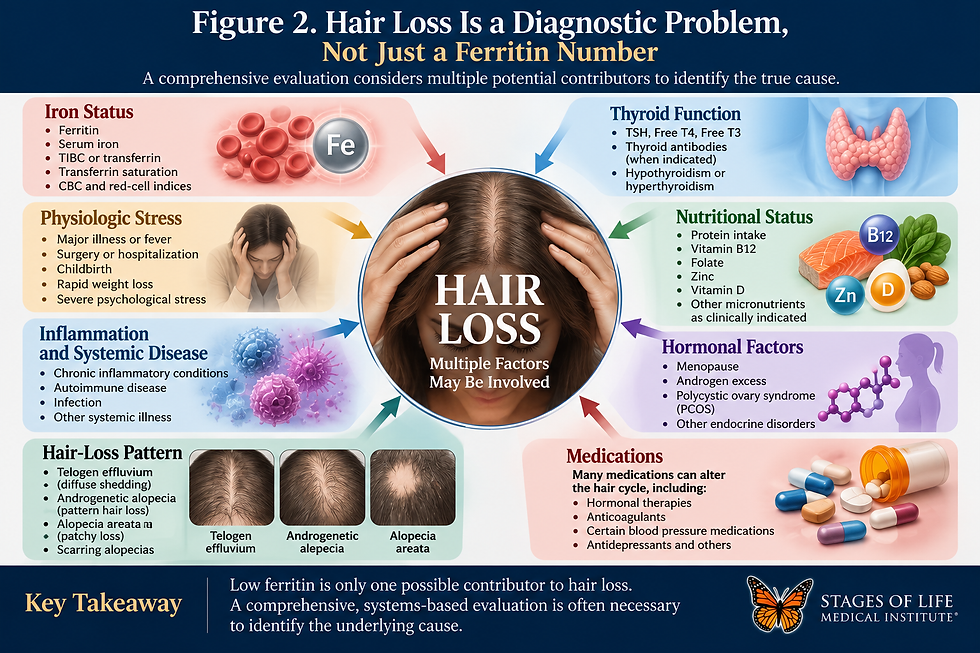
Many affected women have normal circulating androgen concentrations. In women, androgen-related follicular susceptibility may coexist with other influences, including aging, menopause, iron deficiency, thyroid dysfunction, and nutritional insufficiency.
Importantly, female pattern hair loss is not proof of hyperandrogenism or polycystic ovary syndrome (PCOS). When hair loss accompanies hirsutism, acne, menstrual irregularity, or other signs of androgen excess, a more detailed endocrine evaluation becomes appropriate.
6. Is Every Case of Hair Loss Caused by DHT?
Certainly not.
Hair loss is a clinical finding, not a diagnosis.
Several conditions can produce thinning or shedding that resembles androgenetic alopecia.
Cause | Typical clinical clues |
Androgenetic alopecia | Gradual patterned thinning and follicular miniaturization |
Telogen effluvium | Diffuse shedding after illness, surgery, weight loss, or physiological stress |
Iron deficiency | Diffuse shedding, sometimes with low ferritin |
Thyroid dysfunction | Diffuse thinning with other systemic symptoms |
Alopecia areata | Discrete patches or more extensive autoimmune hair loss |
Nutritional deficiency | Inadequate protein, zinc, or other essential nutrients |
Scarring alopecia | Inflammation, altered scalp skin, and potentially permanent follicular loss |
Multiple conditions may coexist. For example, a patient with mild androgenetic alopecia may experience a dramatic increase in shedding following a severe illness or the development of iron deficiency. Treating DHT alone would not necessarily address the second problem.
7. What Your Doctor May Evaluate Before Recommending Treatment
At Stages of Life Medical Institute, we believe the evaluation of hair loss should begin by identifying its underlying mechanism.
A useful assessment includes the distribution and duration of hair loss, family history, medication exposures, recent illness, dietary changes, and associated endocrine symptoms.
Depending on the presentation, laboratory testing may include:
Complete blood count and ferritin
Thyroid-stimulating hormone, with additional thyroid testing when indicated
Testosterone and other androgen measurements when clinical signs suggest androgen excess
Prolactin or additional endocrine testing in selected patients
Nutritional assessment when dietary inadequacy or malabsorption is suspected
Scalp examination and dermoscopy can help identify follicular miniaturization, inflammation, or scarring. Occasionally, a scalp biopsy is necessary.
Routine measurement of serum DHT is not generally recommended for diagnosing typical androgenetic alopecia because serum concentrations correlate poorly with the extent of hair loss.

8. Can DHT-Related Hair Loss Be Treated?
Yes. Several treatments can slow progression, preserve existing hair, and sometimes increase hair density.
Finasteride
Finasteride inhibits type II 5-alpha-reductase, reducing the conversion of testosterone to DHT.
Oral finasteride 1 mg daily is FDA-approved for male pattern hair loss.
It can slow progression and improve hair counts in many men, although benefits require continued treatment.
Potential adverse effects include sexual dysfunction, breast symptoms, and mood-related concerns.
Finasteride also reduces PSA concentrations, which must be considered when interpreting prostate cancer screening results.
Dutasteride
Dutasteride inhibits both type I and type II 5-alpha-reductase and generally suppresses DHT more extensively than finasteride.
It is used off-label for androgenetic alopecia in the United States and may provide greater hair-growth efficacy in some patients.
Its longer half-life and potential adverse effects warrant individualized discussion.
Minoxidil
Minoxidil works through mechanisms distinct from direct DHT suppression. It can prolong or support the growth phase and improve hair density.
Topical minoxidil is an established treatment for male and female pattern hair loss.
Low-dose oral minoxidil is sometimes prescribed off-label, but requires consideration of edema, hypotension, tachycardia, and other cardiovascular effects.
Other approaches
Selected women may benefit from antiandrogen therapy, such as spironolactone, when clinically appropriate. Pregnancy potential and medication contraindications require particular attention.
Hair transplantation, platelet-rich plasma, and low-level light therapy are additional options for selected patients, although the quality and consistency of supporting evidence vary.
9. Should Everyone With Hair Loss Try to Lower DHT?
No.
DHT is a physiologically important hormone. Suppressing it without a clear indication may expose patients to unnecessary adverse effects. Moreover, treatments directed at DHT will not correct hair loss caused by iron deficiency, thyroid disease, telogen effluvium, or inflammatory scalp disorders.
The appropriate question is not simply, "How can we lower DHT?"
It is, "What is causing this patient's hair follicles to produce less hair?" That distinction is the difference between treating a laboratory value and treating a patient.
Frequently Asked Questions
Can I have DHT-related hair loss with normal testosterone?
Yes.
Most individuals with androgenetic alopecia do not require elevated serum testosterone or DHT to develop hair loss.
Will lowering DHT regrow all my hair?
Not necessarily.
Treatment is generally more successful at preserving existing hair and improving partially miniaturized follicles than restoring hair in long-standing, severely affected areas.
Does creatine increase DHT and cause hair loss?
A small early study suggested increased DHT concentrations after creatine loading, but subsequent evidence has not established that creatine supplementation causes androgenetic alopecia. A more recent randomized trial found no significant adverse effect on measured hair parameters.
Does shampoo remove DHT from the scalp?
Ordinary shampoo does not meaningfully suppress follicular androgen signaling. Some medicated shampoos may help associated scalp inflammation, but they should not be considered equivalent to established treatments for androgenetic alopecia.
Can women use finasteride?
Finasteride is sometimes prescribed off-label in carefully selected women, but evidence is variable and it is contraindicated during pregnancy because of potential effects on male fetal development.
Bottom Line
DHT is a major contributor to androgenetic alopecia, but DHT concentration alone does not determine who loses hair.
Genetic susceptibility, local hormone metabolism, and the biological behavior of individual follicles are crucial.
Equally important, not all hair loss is androgen-related. Iron deficiency, thyroid disorders, nutritional problems, inflammatory diseases, and physiological stress may produce similar symptoms or worsen existing pattern hair loss.
The best results begin with an accurate diagnosis rather than indiscriminate hormone suppression.
Continue Your Journey to Better Health
Hair loss frequently reflects the interaction of hormonal, nutritional, metabolic, and genetic influences. Understanding these relationships can help patients distinguish inherited follicular sensitivity from potentially reversible causes of hair loss.
References
Lolli F, Pallotti F, Rossi A, et al. Androgenetic alopecia: a review. Endocrine. 2017;57:9–17. PubMed
Kaufman KD, Olsen EA, Whiting D, et al. Finasteride in the treatment of men with androgenetic alopecia. J Am Acad Dermatol. 1998;39:578–589. PubMed
Varothai S, Bergfeld WF. Androgenetic alopecia: an evidence-based treatment update. Am J Clin Dermatol. 2014;15:217–230. PubMed
Lak M, et al. Does creatine cause hair loss? A 12-week randomized controlled trial. J Int Soc Sports Nutr. 2025. PubMed.
PubMed
American Academy of Family Physicians. Hair loss: diagnosis and treatment. Am Fam Physician. 2024. Clinical review.
AFP
U.S. National Library of Medicine. Finasteride tablets, prescribing information. Revised June 2026. DailyMed.
DailyMed
At Stages of Life Medical Institute, we believe symptoms rarely occur in isolation. Our approach emphasizes understanding the interactions among hormones, metabolism, nutrition, and underlying disease before selecting treatment.
Become a Patient
If you are experiencing unexplained hair loss, a comprehensive medical evaluation may help identify contributing factors and determine whether treatment is appropriate.
Stages of Life Medical Institute
1917 Boothe Circle,
Longwood, Florida 32750
407-679-3337
Medical disclaimer: This article is intended for educational purposes and does not replace individualized medical evaluation, diagnosis, or treatment.
Continue Your Journey to Better Health
Hair loss is rarely explained by a single laboratory value. Although dihydrotestosterone (DHT) plays an important role in androgenetic alopecia, thyroid disorders, iron deficiency, nutritional imbalances, and metabolic dysfunction may independently contribute to thinning hair.
At Stages of Life Medical Institute, our approach is to understand these interacting physiological processes rather than automatically attributing hair loss to excessive androgen activity.
Explore these related articles from our medical education library:
Low iron stores may contribute to diffuse hair shedding, even without anemia. Learn why ferritin must be interpreted in clinical context rather than treated to an arbitrary target.
Discover how oral iron supplementation affects ferritin, why absorption varies, and why increasing iron stores does not necessarily restore hair growth.
Autoimmune thyroid disease may contribute to hair thinning, fatigue, dry skin, and metabolic changes. Learn how thyroid dysfunction can complicate the evaluation of androgen-related hair loss.
Explore the relationships among thyroid function, nutritional status, insulin resistance, inflammation, and other systemic disorders that may coexist with hair loss.
Our Systems-Based Philosophy
At Stages of Life Medical Institute, we believe symptoms rarely occur in isolation. The body functions as an integrated system in which hormones, metabolism, nutrition, inflammation, and genetics continuously interact. Lasting improvement begins by identifying the underlying mechanisms rather than simply suppressing isolated symptoms.
References
Lolli F, Pallotti F, Rossi A, et al. Androgenetic alopecia: a review. Endocrine. 2017;57(1):9–17. PubMed
Kaufman KD, Olsen EA, Whiting D, et al. Finasteride in the treatment of men with androgenetic alopecia. J Am Acad Dermatol. 1998;39(4):578–589. PubMed
Varothai S, Bergfeld WF. Androgenetic alopecia: an evidence-based treatment update. Am J Clin Dermatol. 2014;15(3):217–230. PubMed
Lak M, et al. Does creatine cause hair loss? A 12-week randomized controlled trial. J Int Soc Sports Nutr. 2025. PubMed
Medical Disclaimer
This article is intended for educational purposes and does not replace individualized medical evaluation, diagnosis, or treatment. Medications that alter androgen metabolism may have clinically important adverse effects and should be used only under appropriate medical supervision.
The medical references cited in this article are provided for educational purposes only and are intended to support general scientific discussion. They are not a substitute for individualized medical advice, diagnosis, or treatment. Clinical decisions should always be made in consultation with a qualified healthcare professional who can account for a patient’s unique medical history, medications, and circumstances.


1917 Boothe Circle, Suite 171
Longwood, Florida 32750
Tel: 407-679-3337
Fax: 407-678-7246

© 2026 Stages of Life Medical Institute. All rights reserved.



Comments