


Alpha Lipoic Acid and Healthy Aging

What This Powerful Antioxidant Means for Your Long-Term Health

When patients ask me about supplements for longevity, I don’t start with marketing claims. I start with biology.
Aging is driven largely by a few core processes:
Mitochondrial decline
Oxidative stress
Insulin resistance
Vascular dysfunction
Chronic inflammation
Alpha lipoic acid (ALA) is one of the few compounds that meaningfully intersects with all of these.
Let me walk you through what that means for you.

What Is Alpha Lipoic Acid?
Alpha lipoic acid is a compound your body actually makes in small amounts. It lives inside your mitochondria — the energy-producing structures inside your cells.
There, it helps key enzyme systems convert food into usable energy¹.
As we age, mitochondrial efficiency declines. When that happens:
Energy drops
Oxidative stress rises
Inflammation increases
Insulin resistance becomes more likely
Supplementing with ALA does not “reverse aging,” but it can support the systems that decline with age.
Why Oxidative Stress Matters
Oxidative stress is simply cellular “wear and tear.” It accumulates slowly over decades and contributes to:
Atherosclerosis
Neurodegeneration
Insulin resistance
Endothelial injury
Alpha lipoic acid is unique because it:
Directly neutralizes free radicals²
Regenerates vitamin C and vitamin E³
Helps restore glutathione — your body’s master antioxidant³
Rather than acting in one pathway, ALA helps support your entire antioxidant system.
When we talk about insulin resistance, most people think of diabetes. But elevated insulin over time drives:
Vascular inflammation
Weight gain
Fatty liver
Increased cardiovascular risk
Accelerated cognitive decline
ALA has been shown to improve insulin sensitivity⁴ and increase glucose uptake into muscle cells⁵. Some studies show improvement in metabolic markers in patients with insulin resistance⁶.
For many patients, improving insulin sensitivity is one of the most powerful steps toward long-term disease prevention.
Nerve Health and Brain Protection
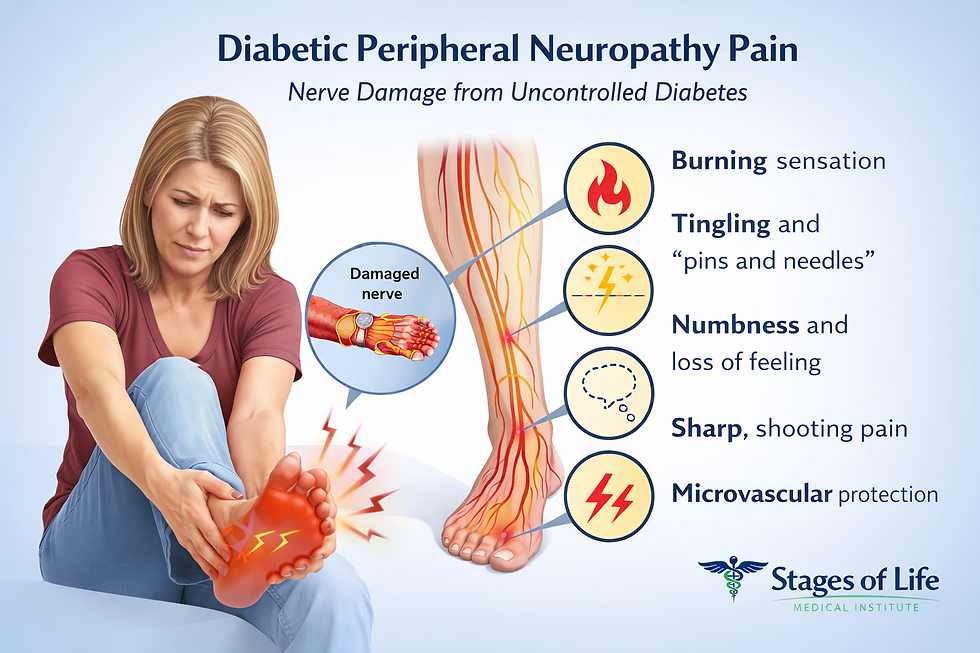
One of the strongest clinical uses for ALA is diabetic neuropathy. In Europe, it is widely used to treat nerve pain⁷.
ALA:
Reduces oxidative stress in nerve tissue
Improves nerve conduction⁷
Crosses the blood–brain barrier⁸
There is also emerging evidence suggesting possible benefit in early cognitive decline⁹.
While it is not a treatment for dementia, it supports mitochondrial and antioxidant systems that protect brain cells.
Vascular Protection
Your blood vessels are lined with delicate endothelial cells. These cells regulate:
Blood pressure
Clotting
Inflammation
Arterial flexibility
Oxidative stress damages this lining over time.
ALA has been shown to improve endothelial function¹⁰ and support nitric oxide availability, which helps maintain healthy vascular tone.
Since cardiovascular disease remains the leading cause of mortality, protecting the endothelium is central to longevity.
Who Might Benefit?
Clinical Benefits of Alpha Lipoic Acid (ALA) in Diabetes and Diabetic Neuropathy
Category | Clinical Effect | Mechanism | Practical Relevance for Patients |
Insulin Sensitivity | Improves glucose uptake | Enhances GLUT4 translocation and insulin signaling | May reduce insulin resistance and improve metabolic control |
HbA1c & Glycemic Markers | Modest improvement in some studies | Reduced oxidative stress and improved cellular glucose handling | Adjunct support in prediabetes and type 2 diabetes |
Oxidative Stress Reduction | Lowers reactive oxygen species (ROS) | Direct antioxidant activity and glutathione regeneration | Protects pancreatic beta cells and vascular endothelium |
Endothelial Function | Improves nitric oxide bioavailability | Reduces oxidative inactivation of NO | Supports vascular health and reduces microvascular injury |
Nerve Conduction Velocity | Improves nerve signal transmission | Reduces oxidative injury in peripheral nerves | May improve numbness and sensory deficits |
Neuropathic Pain Reduction | Decreases burning, tingling, and paresthesias | Anti-inflammatory and antioxidant effects in nerve tissue | Symptomatic relief in diabetic neuropathy |
Microvascular Protection | Reduces capillary damage | Improves endothelial stability | May slow progression of diabetic complications |
Inflammatory Marker Reduction | Lowers pro-inflammatory cytokines | Modulates NF-κB and oxidative signaling pathways | Supports systemic metabolic stability |
Mitochondrial Support | Enhances ATP production | Cofactor for key mitochondrial enzymes | Improves cellular energy efficiency |
Safety Profile | Generally well tolerated | Minimal systemic toxicity at typical doses (300–600 mg daily) | Suitable as adjunct therapy under physician supervision |
In my clinical practice, ALA is most often considered in patients with:
Insulin resistance or prediabetes
Metabolic syndrome
Diabetic neuropathy
Early vascular dysfunction
Elevated oxidative stress markers
It is rarely used in isolation. It works best as part of a comprehensive strategy that includes:
Nutrition optimization
Resistance training
Sleep correction
Micronutrient repletion
Metabolic evaluation
Dosing and Safety
Typical oral dosing:
300–600 mg daily
Sometimes up to 1,200 mg daily in neuropathy protocols
It is best absorbed on an empty stomach.
ALA is generally well tolerated. Mild gastrointestinal upset can occur. Because it can improve insulin sensitivity, patients prone to hypoglycemia should be monitored.
A Realistic Perspective on Longevity
No supplement prevents aging. But some compounds target core biological drivers of disease.
Alpha lipoic acid supports:
Mitochondrial efficiency
Redox balance
Insulin sensitivity
Endothelial health
Those are central pillars of preventive medicine.
Used thoughtfully, and within a physician-guided plan, ALA can be a rational component of long-term health optimization.
Bottom Line
Alpha lipoic acid is more than an antioxidant. It is a mitochondrial cofactor and metabolic regulator that supports vascular and nerve health. For patients working to reduce insulin resistance, protect vascular function, and maintain cellular resilience, ALA may play a meaningful role in a broader longevity strategy.
Become a Patient
If you would like a personalized evaluation of your metabolic health, oxidative stress profile, and longevity strategy, schedule a consultation with Stages of Life Medical Institute. Preventive medicine works best when it is individualized.
References
Reed LJ. J Biol Chem. 2001;276(42):38329–38336.https://pubmed.ncbi.nlm.nih.gov/11584005/
Packer L, et al. Free Radic Biol Med. 1995;19(2):227–250.https://pubmed.ncbi.nlm.nih.gov/7649491/
Bast A, et al. J Clin Biochem Nutr. 2007;40(2):69–74.https://pubmed.ncbi.nlm.nih.gov/18175938/
Jacob S, et al. Free Radic Biol Med. 1999;27(3–4):309–314.https://pubmed.ncbi.nlm.nih.gov/10468203/
Konrad D, et al. Diabetes. 2001;50(6):1464–1471.https://pubmed.ncbi.nlm.nih.gov/11375347/
Ansar H, et al. J Diabetes Complications. 2011;25(2):115–120.https://pubmed.ncbi.nlm.nih.gov/20488683/
Ziegler D, et al. Diabetes Care. 2006;29(11):2365–2370.https://pubmed.ncbi.nlm.nih.gov/17065691/
Shay KP, et al. Biochim Biophys Acta. 2009;1790(10):1149–1160.https://pubmed.ncbi.nlm.nih.gov/19664690/
Hager K, et al. Arch Gerontol Geriatr. 2007;45(3):261–269.https://pubmed.ncbi.nlm.nih.gov/17098340/
Sola S, et al. Circulation. 2005;111(3):343–348.https://pubmed.ncbi.nlm.nih.gov/15655133/
The medical references cited in this article are provided for educational purposes only and are intended to support general scientific discussion. They are not a substitute for individualized medical advice, diagnosis, or treatment. Clinical decisions should always be made in consultation with a qualified healthcare professional who can account for a patient’s unique medical history, medications, and circumstances.


1917 Boothe Circle, Suite 171
Longwood, Florida 32750
Tel: 407-679-3337
Fax: 407-678-7246


.webp)